Posts

Colombian Halloween

While October 31st is Halloween here in the US, there is a similar -- typically -- less scary holiday in Colombia on the same day. Until 2001, it was called Día de los Niños. However, in 2001, spurred on by the ICBF and concerns over the violent nature of Halloween, the official title of Día de los Niños was removed and passed on to the last Saturday in the month of April -- it is called the Día de los Niñez y Recreacion . Halloween is now just Halloween or Noche de Brujas. On this day, children dress up as their favorite character. Walking the streets, you will see Batman, fairies, dogs, cats, ninjas, cowboys, princesses, etc. The children will get candy, balloons, ice cream and other gifts in celebration. Unlike here in the US, where kids go from house to house seeking candy. Most kids are taken to shopping malls or grocery stores (Centros Comerciales) where they ask for and receive candy. So, what is the Colombian Trick or Treat saying? It goes like this: Triqui Triqui Halloween...

Coconut Handicrafts

Image
Until the year 1853, cotton was the major agricultural focus on the Islands (San Andrés , Santa Catalina and Providencia ). However, after this date, agriculture became more and more focused on Coconuts. Coconuts became prevalent in both the gastronomy and economy of the islands. The fiber from the coconut tree branches is used to make hats, baskets, wall hangings and rugs. The shells are used in a myriad of other handicrafts. There are the practical handicrafts -- bowls, spoons, lamps, cups and dishes. Those used to beautify -- necklaces, earrings, bracelets, and belts. Yet another great idea for a Colombian souvenir, particularly if your child was born on the islands or if you choose to visit there. Picture: http://www.free-clipart-pictures.net/tree_clipart.html

Festival de la Luna Verde -- Green Moon Festival

El Festival de la Luna Verde or the Green Moon Festival got its start in 1988, with the 1st annual festival. The Festival was designed to celebrate the Affro Caribbean roots of the islands (San Andres, Santa Catalina and Providencia ). According to an article I read in El Tiempo , the festival is unfortunately no longer held. However, here is what it was like. The party would begin with a parade to all parts of the island, following the roads, accompanied by music. There were marches and dances hearkening back to dances from Ghana and other African places. At night there were music competitions from groups representing European folkloric music like polka and chottis that has influenced the people of the islands. There were also presentations paying homage to the population's African roots. These groups used drums, shells and other native African instruments -- they called this the Congo Meeting. The festival also included musicians from all quarters of the Cari...

Rondón or Rundown -- Not to Miss Cuisine

Image
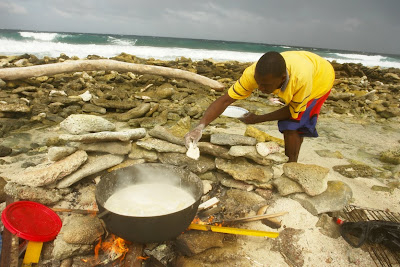
One of the classic dishes of the Islands (San Andrés, Santa Catalina and Providencia) is Rundown or Rondón. Using coconut milk as the broth base, you add snail, pig tail, and fish (sometimes shrimp, crab or lobster are added) as the meat. You also add to the meat green plantains, yuca, breadfruit, yams, dumplings and spices. It is usually cooked outside and most often on the beach in a large pot over an open fire. This unique and VERY typcial dish is well worth a whirl if you get a chance to visit San Andrés while in Colombia * Photos http://www.flickr.com/photos/maqroll/2203197615/in/photostream/ http://www.flickr.com/photos/maqroll/2203991330/in/photostream/

San Andrés and Providencia

Image
One of the most important places for Afrocolombians are the islands of San Andrés, Providencia and Santa Catalina. They have an amazing history, which is as follows: During the 1600's, while Spain and Portugal flourished because of their possessions in the new world, France and England became jealous and angry. They wanted a piece of the pie. However, Pope Alexander I had divided the New World in 1493, drawing an imaginary line between the North and South Pole, giving Portugal possession of lands on one side and Spain possession of lands on the other side. As a result, France and England were excluded from the riches of the New World. The English adopted a belligerent attitude and in 1558, they began an organized, state sponsored, campaign of piracy -- known in English as PRIVATEERING. This tactic was designed to weaken Spain. Pirates such as Sir John Hawkins, Sir Francis Drake, and Henry Morgan stole from the Spanish Armada as they attempted to take the riches from America back to...

Pollo Gritador

Yesterday, I mentioned an option for not to miss cuisine -- Pollo Gritador -- Screaming Chicken. Today, I will provide the recipe so that you could try this on your next Bar-B-Q. Step #1 Take 5 pounds of chicken breast , clean and pound them so that they are even and will cook evenly. Step #2 In a food processor, mix the following. 2 large tomatoes 4 green onions 1 medium onion finely chopped 2-3 cloves of garlic 4 sprigs of cilantro -- cut off the stem 1/2 teaspoon ground cumin 1 teaspoon chicken broth instant powder (I like Herb-ox my MIL uses Knorr ). Salt to taste, if necessary Once ingredients are all mixed and chopped up in the food processor, I cook them in a frying pan on medium in: 3-4 Tablespoons butter (I use regular Smart Balance instead). Cook the GUISO in the butter until everything is tender and the onions just start to brown. Take off the stove. Step #3 Fork chicken and marinate the chicken in about 2 cups of Hogao . Let the chicken marinate over night. Step #4 2 h...

Not to Miss Cuisine - Asado Huilense

The most typically food associated with the Festival de San Pedro (Festival Folclórico de Bambuco ) in Huila is the famous ASADO HUILENSE or Hulian Bar-B-Q. Though each family probably has its own take on the amount of spices and the kinds of spices used, however, the overall idea and taste of the Bar-B-Q is the same. You can use some or all of the following ingredients: Carne de cerdo -- Pork Cerveza -- Beer Spices: Ajo -- Garlic Pimentón -- Green Pepper Cebolla larga -- Green onions Laurel -- Bay leaf Tomillo -- Thyme Yerba buena -- Spearmint Albahaca -- Basil Cilantro Poleo -- Pennyroyal (a kind of mint plant) Oregano Naranja agria -- Bitter orange Nuez Moscada -- Nutmeg Canela -- Cinnamon Sal -- Salt Pimienta -- Pepper The pork is marinated in the beer/spice marinade for at least 24 hours. Then, you put it in a clay tray and place it in the oven -- they use a brick and clay oven. Look at the cool video: http://www.youtube.com/watch?v=Wa9XKdoOmh0 I couldn...