Posts

Showing posts with the label Altiplano Cundi-Boyacense

Wednesday's Wonders: Papas Chorreadas -- Smothered Potatoes

PAPAS CHORREADAS -- Smothered Potatoes INGREDIENTS 12 small lightly salted boiled potatoes (with or without skin) ½ cup chopped onion 1 cup diced tomatoes ½ Tablespoon butter 1 Tablespoon oil ¼ teaspoon salt (this can be optional) ¼ teaspoon pepper 3 Tablespoons milk 1 Tablespoon flour dissolved in the milk 1 teaspoon chicken broth granules (I use Herb Ox) dissolved in the milk INSTRUCTIONS 1. Fry the onion in the butter and oil. 2. When it begins to brown add the tomatoes, salt and pepper. 3. Cook for 5 minutes 4. Add flour milk mixture and allow to thicken. 5. Place the sauce over the potatoes and serve.

Myths for Monday -- The Real Legend of El Dorado

Few Legends have had a greater impact on the History of the America than that of EL DORADO!!! It's name stirs up Hollywood type images. But did you know that the Legend that started it all came from a small area in what is now the department of Cundinamarca -- today's source of our Myth for Monday? In a way it is hard to call today's story a myth, because in reality, it was not. The Legend of El Dorado was well rooted in an actual practice of the Muisca/Chibcha Indians of the Altiplano Cundiboyacense (what is today the departments of Boyacá and Cundinamarca). The myths that were spawned by this historical practice, however, are legendary. I now present to you the HISTORY that SPAWNED THE LEGEND: EL DORADO -- THE GOLDEN ONE Among the Musicas, the kingship was not passed from Father to Son as it was in Europe. Rather, it was passed from the king to his nephew -- the oldest son of his oldest sister. This occurred in an elaborate ceremony that took place at the lake in...

One Family's Return Trip: The Corner Store

Image
In Colombia, on nearly every street there is a corner store -- TIENDA. They are filled with candy, gum, chips, sodas, beer, bread, matches, and all sorts of odds and ends. These are like magnets for Colombian children. That is a problem for parents wanting their kids to eat healthy while visiting cousins that are used to eating tons of GALGUERÍAS (junk food). After many, many NOs, the boys finally wore us down -- Cokes, Patacones (plantain chips) and Chicken flavored potato chips. This is an important cultural note. There are some "Can't really say you've been to Colombia, unless you've tried them." Galguerías. Below, is our list. Feel free to add your favorite. #1 Chocolatina Jet: Inside the wrapper you will find a sticker. You can purchase a book for about $3 where all of the stickers go. The book then serves as a kind of picture encyclopedia. #2 Papas Fritas Margaritas: It is well worth trying the POLLO (chicken) and LIMON (lime) flavored varieties of Papas ...

One Family's Return Trip: Buying Bread

Image
My husband jokes that being Colombian means that you could never do the Atkins diet because rather than an all protein diet, you are pretty much on the all carbohydrate diet. Not a lunch is served without rice, not a breakfast without arepa and/or bread. But, not the milquetoast sliced bread we buy here -- NOOOOOO ! It has to be the fresh, baked within the last hour kind. In fact, though sliced bread is available at stores like Carrefour or Carrulla . DO NOT BUY IT! It is dry and gross. Only good for toast, and not many people have toasters. Back to the bread. In smaller cities, there are PANADERÍAS everywhere. In Bogotá they are harder to find. But, they smell delicious!!! Your nose can literally lead you to them. You can know that you have found a good one if there are lots of people buying bread there. In some cases, the bread is behind glass containers and you tell the workers which kind you want. In others, like the one pictured here, you grab a basket or tray, a pair of tongs,...

One Family's Return Trip: Iza and El Batán

Image
The area between Paipa and Iza is famous for it's many hot pools. Just outside of Iza, there is a great hotel and pool called El Batán. For $40 per night per couple you can stay and enjoy the "therapautic" waters. Or, for $5, you can jut go for a swim in the pools. (I know they look green, but we were told that this is because of the minerals in the volcanic waters. ) Everyone had fun and no one got sick, in fact my son's eczema cleared up -- maybe there is something to those healing waters after all. After swimming we picked up coconut ice cream in the snack shop -- soooooo delicious! Definitely a must try!! If you are interested in visiting El Batan the phone number for reservations is:578 779-0000.

One Family's Return Trip: Tejo

Image
We spent the afternoon of Independence Day eating and playing Colombia's official national sport -- Tejo. Tejo has its roots in the native Muisca culture. Originally called Turmequé, the sport has been played on the Altiplano Cundiboyacense for over 500 years. It was the sport of the Indian aristocracy, who used a gold disc and simply threw it into a circle placed in clay. Today, the game is played on a field called a cancha, about the size of one really wide bowling lane (2.5 meters wide x 19.5 meters long). On each end, you'll find an angled container filled with clay. In the center is the round metal target, called a bocin. There are also triangular pouches of gun powder (called mechas ) in the clay. The object of the game is to throw a tejo (a small metal disc weighing about 1/2 - 1 pound) into the bocin and blow up a mecha -- if you do this you get 9 points. If you throw the tejo and hit the bocin, but there is no gunpowder explosion, then you get 6 points. There are a fe...

One Family´s Return Trip: Tía Isabel

Image
Most Colombians probably wouldn´t claim their relatives that live on remote mountain sides, but we love to visit Tía Isabel and Tío Castro. It is like going back in time 100 years. This time the boys learned to milk cows. And cut grass with machetes. In Colombia, having Indian ancestry isn´t exactly something to brag about. But, after tracing my husband´s roots back 8 generations (and sometimes up to 10 generations), we have made the discovery that he has Indian ancestry. He is, in fact, part Chibcha. Even if we hadn´t have found proof, we might have suspected it based on this father´s family tradition of pot making, that somewhere back there someone was an Indian who practiced the traditional art of pot making. Read more about Tía Isabel and her world famous pots here: http://raisingcolombiankids.blogspot.com/2009/08/tia-isabel-our-famous-potter-of.html

One Family´s Return Trip: Pantano de Vargas

Image
Pantano de Vargas is the site of a decisive battle for Bolivar´s troops. It is also where the Lanceros became famous. At one point in the battle, Bolivar lamented aloud that he was feeling that all was lost. Juan Jose Rondón reproached Bolivar saying, ¨How can you say all is lost, if my men have not yet fought?¨ Bolivar turned to Rondón and said, ¨Coronel, Salve usted la Patria!¨ (You go save the country). Rondon took his cavalry of 14 lance carrying men, and did just that. Read a bit more of the story here: http://raisingcolombiankids.blogspot.com/2009/03/pantano-de-vargas.html Only one lancero lost his life, Inocencio Chincá. Today, many military high schools and the School for army subofficals are named in his honor. Also, the Colombian Special Forces Commandos are called Lanceros. Very few soldiers are invited to attend the Lancero school, and even fewer ever graduate. One of the tests that soldiers aspiring to be Lanceros are forced to complete is to be dropped in the jungl...

One Family´s Return Trip: Soccer Ball Capital

Image
Mongui is known as the soccer ball capital of Colombia. The balls are all hand made. Here are the steps we got to see in our tour of a ¨fabrica de futbol¨. Step 1: Take the preinflated bladder (the green ball). Cover it with several layers of string and glue, and then allow it to dry. Step 2: Place the cover on. This can be done with hand sewn leather or a synthetic rubber. Step 3: Polish and prepare to sell.

One Family´s Return Trip: Mongui

Every year in Boyacá, there is a competition to see which Pueblo is the prettiest. Several times, Mongui has been the winner of the competition. Mongui is a quiant village near the top of a mountain range. Here is a brief video tour.

One Family´s Return Trip: Sogamoso -- Sun and Steel

Image
Sogamoso is known as the City of Sun and Steel. Why the City of Sun? It comes from the ancient Chibcha traditions. Sogamoso was originally named Suamox, and was the religous capital of the Chibcha empire. While the Zipa (in Bogota) and the Zaque (in Tunja) fought constantly, Suamox was considered a place where niether side could battle, and yet both would come there to worship. It was the site of the Temple of the Sun and the High Priest -- the last one was called the Sugamuxi. As the City of the Sun, there was a statue built in the main plaza to honor the indigenous peoples and their worship of the Sun. Originally, the statue had indian women worshipping the rising sun and the indigenous women faced East. Unfortunately, the statue faced the Main Cathedral. The father of the catherdral complained and is was decided that the indians should be turned around and face West. This was done. Then, people began to complain that the women were worshipping the rising sun not the setting sun. So...

One Family´s Return Trip: Museo Arqueológico

Image
One of the places we always visit when we come to Colombia is the Museo Arqueológico in Sogamoso, Boyacá. The Museum is about 3 hours North of Bogotá on a safe road. It was established to house the remnants of the Musica/Chibcha culture. The Chibchas were the indigenous group that lived on the Altiplano Cundiboyacense prior to the Spanish arrival. The museum has rebuilt the original ceremonial center of the town, including the Temple of the Sun. There are numerous displays including several mummies (boys seem to really like those), pottery, weapons, shrunken heads, and even skulls. They show how the Chibcha skull is quite different from your typical skull. Most of us have 3 bones that grown together after birth. Chibcha skulls have 4, 5, or even 6 bones that grown together. Pretty cool! The area is actually an archeological site that is still under investigation. At certain times you can see archeology students from the UPTC (Universidad Pedogogica y Tecnologica de Colombia) working o...

One Family´s Return Trip: Monumento a Pedro Pascasio Martínez

Image
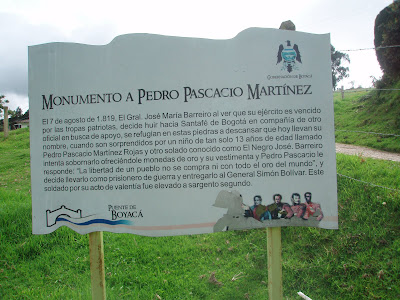
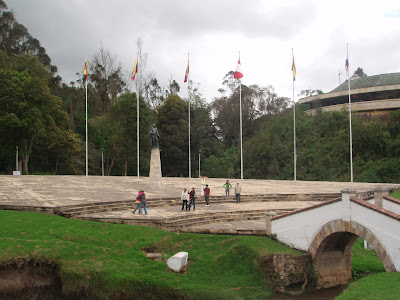
In researching my husband´s family history we discovered that he is a distant relative of a famous Colombian hero -- Pedro Pascasio Martínez Rojas. Please take a moment to read this post that I wrote about this child hero: http://raisingcolombiankids.blogspot.com/2009/08/pedro-pascasio-child-hero-with.html This is our family paying homage to our famous ancestor. This monument is located about 1/4 mile off the main road. If you are coming from Bogotá, you will turn onto a dirt road to your right. The road is just a bit before you get to Puente Boyacá. So, you can visit it first.

One Family´s Return Trip: Puente Boyacá

Image
A few weeks ago, I mentioned that it is Colombia´s Bicentennial. We have been excited to teach our little guys about Colombian Independence, so right after we celebrated the Fourth of July, we began a discussion about Colombia´s Independence. Part of the learning process included plans to visit several important historical sites. One of the most important is Puente Boyacá. Puente Boyacá is located about 1 1/2 - 2 hours North of Bogotá. The road in most places is a divided highway and travel there is easy and safe. This is the site of the final battle where Simon Bolivar won independence for what is today Colombia -- the equivalent to Yorktown in the US. To learn more about this battle, read my post here: http://raisingcolombiankids.blogspot.com/2009/08/battle-of-boyaca-preparing-for-august.html The day we stopped, we were fortunate to see Colombian soliders practicing for the July 20th and August 7th celebrations. They were dressed in the uniforms of the time. It was cool to s...

Bogotá for Beginners: Taxis

Image
Taxis are another great way to get around Bogotá. There are multiple services. It is best to call ahead and have a cab sent to where you are to pick you up. When you call they give you a "SECRET CODE" which you can use when the taxi shows up so you can be sure it is a taxi from a reputable company -- this keeps you safe :) A really helpful site when looking at public transportation in Bogotá -- buses and taxis -- is found in both English and Spanish at: http://www.bogota-dc.com/trans/bog-tra.htm This site gives you the latest rates, you can hire a taxi for 1 hour at the rate of $14,000 pesos -- about $7.50 US. There is also an added fee for a trip from the airport -- $3,200 (less than $2 US). This also means a ride from the airport shouldn't cost you more than $10. So, don't get ripped off by your agency. You can always send them a link to this site. I heard of one agency charging $30 for a trip from the airport to the hotel. NOT COOL!! That extra $20 can be very usef...

Bogotá for Beginners: Pico y Placa

In a city where there are over one million vehicles, and the streets aren't exactly wide and well planned thoroughfares , there was a need to create a plan to reduce traffic congestion. The transportation solution included the TransMilenio bus system, the new subway, and an interesting system (borrowed from Mexico City) which has come to be know as Pico y Placa . Pico y Placa means that you cannot drive your car on certain days of the week -- based on the last number on your car's license plate. It applies to all vehicles, public and private. For example, cars whose plates end in a 3, 4, 5, or 6 cannot circulate from 6 am until 8 pm on Mondays for the year from July 2009 until June 2010. A violation of this law will cost you over $100 US and you may have your car impounded. This rule often puts a damper on some adoptive families that rely on certain drivers. Inevitably, a driver will be unable to circulate 2 days of the week. This is why getting a handle on public transpor...

National Parks: Chingaza

Image
The Chigaza National Park is located just outside of Bogota (about an hour's drive on paved, well cared for roads) in the Department of Cundinamarca. It offers you an opportunity to get up close and personal with nature -- hiking, camping, birding and photography are your best options here. Established as a National Park in 1977, Chingaza covers about 76,600 hectares. It ranges in elevation from 2,600 feet above sea level (800 meters) to 13,200 feet (4020 meters). At the lower elevations of the park, the climate is rainy and more tropical, while the higher elevations are host to a frigid tundra climate with temperatures reaching below freezing. Most of the year, the area will receive a great deal of rainfall, with mid-December thru February being the dry season. The area receives so much rainfall that a particular moss has adapted to help hold the water. The Spahagnum moss can hold up to 40 time its weight in water. The Park is home to the Chuza Dam, which provides Bogota wi...

Bogotá for Beginners: Museo de Oro

Image
When the Spanish came to what is today Colombia, they heard a tale of a tribe of Indians that were masters of gold. Indians in the Caribbean region spoke of a tribe of Indians that made beautiful gold pieces and that had so much gold that they would paint themselves with it and sacrifice boat loads of gold to their God. Thus began the search for El Dorado (the Golden One). Though the story the Spanish heard was greatly exaggerated, there was indeed a tribe of Indians that made a sacrifice of Gold in what is called the lake of Guatavita. When the Cacique (ka -SEE-kay) of the village of Guatvita died and his successor appointed, the new chief or cacique would indeed be bathed in gold. Then, he sat upon a large wooden raft that was covered in items made of gold. He would float out into the middle of the lake and all of the items would be dumped into the lake then he would jump in and wash off the gold from his skin. The piece pictured here at the left is a representation of that cere...

Bogotá for Beginners: Museo Nacional de Colombia

Image
In the U.S., we have the Smithsonian. In Colombia, there is the Museo Nacional -- the National Museum. The Museum was established almost 187 years ago -- on July 28, 1823. It thas been housed in many locations, but the most recent (from 1948 - the present) is the former Cundinamarca Prison -- which was declared a National Monument in 1975 because of its amazing architecture. A few years ago, a newly restored and updated interior was unveiled. What a change!!! Today the museum boasts permanent and travelling exhibits on 3 different levels. The permanent exhibits consists of 17 areas and over 2,500 pieces. The first floor houses the Pre-Colombian exhibits as well as exhibits from the time of the Spanish Conquest. Gold, pots, mummies, swords -- way cool for little boys!!! You can learn about native Colombians from many different regions -- Tolima, Boyacá, the Coast, etc. The 2nd floor houses exhibits from 1550-1886 -- the Colonization, Independence (including items belonging to Simón Bo...

Bogotá for Beginners: Museo Botero

Image
Back in December, I wrote about the artist Fernando Botero: http://raisingcolombiankids.blogspot.com/2009/12/fernando-botero.html Today, as part of the Bogotá for Beginners series, I would like to talk about the Botero Museum in Bogotá. This truly is a must see for any adoptive family. In 2000, Fernando Botero donated 123 works of art to the art museum that now bears his name. The works include drawings, paintings and sculptures. You can see online photos of the collection here: http://www.lablaa.org/blaavirtual/museobotero/listabot.htm In addition to the works by Botero, you will find other works by the following artists: Corot, Renoir, Bonnard, Dalí, Chagall, Beckmann, Delvaux, Giacometti, Picasso, Miró, Bacon and Moore. The Museum, which is FREE to the public, is located in La Candelaria, right next door to the Casa de la Moneda. The exact address is Calle 11 No. 4-41. Its hours of operation are: Monday - Saturday 9:00 a.m. - 7:00 p.m. Sundays and Holidays: 10:00 a.m. - 5:00 p.m. ...