Posts

Showing posts with the label Flora/Fauna

Borojó

Image
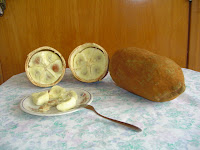
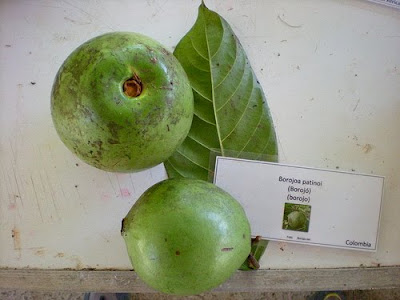
In some parts of Colombia, particularly along the Pacific Coast in El Chocó and Valle, there grows an interesting fruit -- BOROJÓ . The fruit itself is green and about the size of a softball. It grows on trees that are anywhere from 9-15 feet tall. The fruit is highly nutritious. It offers a good source of protein, vitamin B and phosphorus. Research conducted at a Colombian university shows that it contains a substance that can inhibit the growth of cancerous tumors. I got to try the fruit for the first time on our recent trip. People make drinks out of the pulp, which tastes good at first, but has an aftertaste of rotten cheese. I personally couldn't drink it after a few sips. Colombians believe it helps with bronchial infections and it is also considered "nature's viagra ". Photo: http://www.flickr.com/photos/jeandrapp/3734238858/sizes/m/in/photostream/
Seaflower Biosphere Reserve

On the 9th of November, 2000, UNESCO declared the Archipelago of San Andres, Old Providence and Santa Catalina a new Natural Heritage site, naming it the SEAFLOWER BIOSPHERE RESERVE. As such it is one of 391 ecological zones of this type on the planet. There are three main purposes of the reserve: First, is to converse the landscape, ecosystem, species and the genetic variation of the area. Second, is to encourage sustainable economic and human development, while maintaining the sociocultural roots and ecological stability of the region. Finally, the reserve is to provide logistic support to demonstration projects and educational endeavors on islands with relation to conservation and sustainable development. Here is a government video about the Reserve in Spanish: Here is a tourist video in English: Learn more about the Colombian Agency assigned to oversee the Biosphere Reserve here: http://www.coralina.gov.co/intranet/ You can read a report evaluating the Reserve's first five year...

Plant Biodiversity

Image
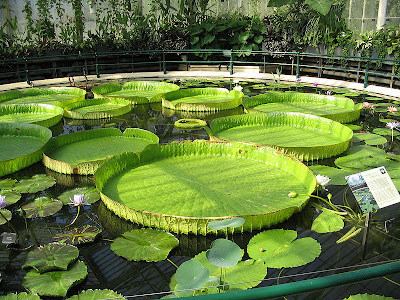
Colombia, which ranks second in the world for plant diversity, is home to about 45,000 different plant species. Only Brazil, a country which is 6 1/2 times larger than Colombia, has more distinct plant species (about 55,000). This means that approximately 15% of plant species world wide are found in Colombia. Colombia is the second largest exporter of flowers to the world. (There is nothing like a Colombian rose on Mother's Day -- May 9th -- Hint! Hint!) One interesting statistic about Colombian biodiversity. Colombia makes up 1% of the planet surface, but it contains 10% of the world's entire biodiversity. Some of the more interesting plants of Colombia include: La Victoria (Victoria regia) which grows large enough for a child to sit on it and float. And the Frailejón (Espeletia schultzii) which grow in the páramo regions of Colombia. Pictures: http://es.wikipedia.org/wiki/Archivo:Victoria_regia_Kew_Gardens.jpg http://en.wikipedia.org/wiki/File:Rossettenstauden.JPG

Orchid Biodiversity

Image
Colombia ranks #1 in world biodiversity in kinds of Orchids. Colombia boast about 3,500 species of orchids, which is about 15% of the entire world species. Amazingly enough, new species are continuing to join the ranks. In fact, just a few short months ago (October 2009) the latest unique species of orchid was announced . The find was made near the city of Yotoco in the department of Valle del Cauca . The new species has been given the name Lepanthes foreroi . Unfortunately, this new species is already threatened by local farmers wanting to expand their farms. You can read more and see a picture here: http://www.elpais.com.co/historico/nov112009/REG/orquidea.html Photo: http://www.flickr.com/photos/camusdazur/3432354948/sizes/l/

Reptile Biodiversity

Image
According to the Colombian government website highlighting the biodiversity in the National Parks, Colombia ranks #3 in the world for diverse species of reptiles. Approximately 6% of all reptile species live in Colombia. There are a plethora of lizards, snakes and turtles, as well as crocodiles, caimans, and gavialide. A few weeks ago, I wrote about Gorgona. So, I thought I would focus on one of the most unique species of lizards that can be found in Colombia. It is called the Lagaritja Azul de Gorgona -- the Blue Lizard of Gorgona (Anolis Gorgonae). The Blue Lizard is very elusive. In fact, several scientists that have tried to study it have found it difficult to find and follow. Therefore, exact numbers are unknown and the species is considered a Critically Endangered species. There has been talk of a captive breeding program, though at this time there is none. It is illegal to collect, export, or purchse the Anolis Gorgonae as it was granted protected status by the Colombian governm...

Feline Biodiversity

Image
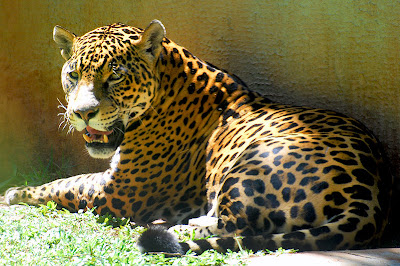
Colombia has 6 different species of felines, and the Colombian Government considers their preservation of major importance because of the high degree of cultural value that these wild cats represent. In actuality, all 6 species are considered either endangered or near endangered species in Colombia. Here is the list if you are keeping track: Jaguar (Pantera Onca) Puma (Puma Concolor) 3. Ocelot (Leopardus Pardalis) 4 . Jaguarundi (Puma Yagouarundi) 5. Margay or Tigrillo (Leopardus Weidii) 6. Oncilla (Leopardus Tigrinus) The Colombian government considers these species an umbrella species because their conservation indirectly facilitates the preservation of many other species because the large cats (jaguars and pumas) need to live in large areas. Thus, if the cats are preserved, so also is the ecology of many areas of the country. For more information, you can check out the following pamphlet: http://www.jaguarnetwork.org/pdf/64.pdf Photos: http://en.wikipedia.org/wiki/File:On%C3%A7...

Primate Biodiversity

Image
According to the Colombian National Parks homepage, Colombia ranks third in the world for the most biologically diverse home to primates. In fact, it is home to 34 different species of primates, including 2 of the top 25 most endangered primates in the world. One is the Mico Tití , of which I wrote several months ago. You can read that post here: http://raisingcolombiankids.blogspot.com/2009/04/el-mico-titi.html The other critically endangered species is the Varigated or Brown Spider Monkey ( Ateles hybridus ) called Mono Araña Marimba in Colombia. This species actually has 2 subspecies one of which is found exclusively in Colombia and the other sharing territory in Colombia and Venezuela. This cutie is suffering from habitat loss, hunting, and an illegal pet trade. Because of habitat loss, only "9% of their potential range exists as continuous forest." You can see this monkey in several Colombian zoos, but they are in need of a captive breeding program. You can re...

Colombian Mushrooms

Image
Author Gunter Pauli has developed an education model, called ZERI, that is designed to teach young children prinicples of science. Using the ZERI Fables book series, he gives children and their parents (or teachers) an opportunity to participate in hands on activities that help kids learn to use principles that they learn in the books. His hope is that children will improve their emotional intelligence, eco-literacy, and artistic/creative capacities. Why am I discussing science learning on a blog about Colombia? Well, Mr. Pauli has a wonderfully illustrated bilingual (SPANISH/ENGLISH) book in his series called: COLOMBIAN MUSHROOMS Pauli has lived and worked in Colombia, and his efforts to improve education, through an integrated approach, have caught on in Medellín and Manizales. You can learn more about his book, and the Fable series it is a part of at Chelseagreen.com. The book is probably best suited for children ages 4-8. http://www.chelseagreen.com/bookstore/item/colombian_mushroo...

Amphibian Biodiversity

Image
Colombia ranks 2 nd in the world for diverse species of amphibians (only Brazil has more). Here are some interesting statistics -- according to a report jointly issued by Conservation International, The World Conservation Union, and Nature Serve : Colombia is home to 698 unique amphibian species. 648 -- frogs and toads 19 -- salamanders 31 -- caecilians Colombia also has the largest number of threatened amphibian species in the world with 208 -- that means about 30% of the amphibian species in Colombia are in threat of extinction. 50 species are critically endangered 78 species are endangered 80 species are threatened An additional 48 species are considered near threatened. A few months ago, I wrote a post about one critically endangered frog species -- the Golden Poison Frog. Read about it here: http://raisingcolombiankids.blogspot.com/2009/06/golden-poison-frog.html Photo: http://www.flickr.com/photos/anthrotect/3516408905/sizes/l/ http://en.wikipedia.org/wiki/File:Bufo_periglenes...

Butterfly Biodiversity

Image
Prepona praeneste or prepona roja de la montaña In Colombia there are an estimated 3800 different butterfly species, with a confirmed count of 3273 as of January 2009 -- ranking the country #2 in the world in terms of butterfly diversity. Like Birds, many species are threatened. Among the threatened species are the Arhuaco ica or mariposa de los arhuacos, Lymanopoda caeruleata or Limanopada azul, Morpho rhodopteron or Morfo Anacarada, all native to the Sierra Nevada de Santa Marta. In addition, the Prepona praeneste or prepona roja de la montaña from the Andean Zone and the Prepona werneri or prepona azul from Chocó are all endangered species. The loss of species is due to the growth of agriculture, cattle, and most importantly the cutting down of trees in order to plant drug crops which are then sprayed with chemicals (thank you US government) that destroy insect habitat. On Flickr there is a group of 54 pictures of Colombian butterflies. You can click here and then click on detail t...

Bird Biodiversity

Image
Did you know that Colombia has the largest number of unique avian species in the world? With 1,871 different species, they rank #1 in avian biodiversity. I am a statistic lover. So here are a few you can throw up on your personal blog or your child can write into their report on Colombia. In 2009, there were 1871 unique, recorded avian species in Colombia. Of those, 1 has been declared officially extinct. Another 13 species are critically endangered, 31 are endangered, 52 are threatened, and 60 near threatened. Currently, there are 15 avian preserves in Colombia. Three in Antioquia, 3 in Santander, and one each in Boyacá, Cauca, Magdelena, Meta, Nariño, Norte Santander, Quindío, San Andrés and Tolima. A few months ago I wrote post about one of the 13 critically endangered species. You can read about it here: http://raisingcolombiankids.blogspot.com/2009/06/indigo-winged-parrot.html Today, I want to focus on the species we have lost. Known as the Zambullidor Bogotano (Colombian Grebe o...

2010 International Year of Biodiversity

We share the planet with 13 million different living species including plants, animals and bacteria, only 1.75 million of which have been named and recorded. This incredible natural wealth is a priceless treasure that forms the ultimate foundation of our wellbeing. The systems and processes of this BIODIVERSITY produce our food, water and the air we breathe – the basic fundamentals of life. However, Biodiversity’s contribution to our life is not just practical, physical and utilitarian, it is also cultural. The diversity of the natural world has been a constant source of inspiration throughout human history, influencing traditions, the way our society has evolved and supplying the basic goods and services upon which trade and the economy is built. The disappearance of unique species is a loss that cannot be calculated and leaves us all much poorer. The UN has declared 2010 the International Year of Biodiversity. As a consequence, a global campaign designed to encourage worldwide action...

Unusual Fruit -- NOT TO MISS CUISINE

Image
Long before I met my husband, I spent 18 months living in Toronto, Canada. Most of the people I lived and worked with were from Latin America. I remember that one of the families I knew was from Colombia. On their wall was a large poster of the many different fruits of Colombia. Dozens of fruits that seemed completely unfamiliar. I remember thinking that it would be great to try all of them. And now, having tried many of them, I must recommend that you try some too. The fruits are definitely one of the NOT TO MISS CUISINE items of Colombia. This week, with the focus on the Amazon regions of Colombia, I thought I would spotlight some of the amazing fruits of the region. Seje -- found in the Amazon and Pacific Coast regions. This fruit is most similar to a date and is the size of a marble. It is cooked before serving. Unfortunately, I could not find a picture of this fruit. Copoazu -- (Theobroma grandiflorum) -- This fruit is a relative of the cacao and its seeds can also pr...

Golden Poison Frog

Image
The Golden Poison Frog (Phyllobates terribilis), from the Pacific Coast of Colombia, is one of the over 100 frogs in the poison dart species. It is also one of the most poisonous animals on earth. The venom contained in just one small frog (about 2 inches long) can kill 10 adults. It is the venom of this frog that has been used by the indigenous Embera people to tip their hunting darts. Though they are called the "Golden" frog, not all of them are yellow in color. Some of the frogs are orange or light green. Their bright coloring warns predators to stay away. Interestingly enough, Golden Poison Dart frogs are a common household pets worldwide. When I first read this, I thought --"You have got to be kidding me!" Then, upon further research, I found out that frogs raised in captivity -- out of their natural environment never develop venom. So, scientists believe that it is something in the environment, probably the plants that are eaten by the insects that serve as t...

Indigo Winged Parrot

The Indigo Winged Parrot or Loro Coroniazul in Spanish (Hapalopsittaca fuertesi) is a critically endangered species. There are thought to be fewer than 250 left in the wild, and none in captivity. This beautiful parrot is mainly bright green with a blue crown. Here is a link to a copyrighted picture of the bird: http://www.oiseaux.net/photos/proaves.fundacion/indigo-winged.or.fuerte.s.parrot.1.html#alpha It is found only on the Western side of the Andes in the departments of Quindío, Risaralda, and Tolima. They prefer living in the cloud forests at elevations of 2,600-3,600 meters. The species was thought extinct. However, in 2002, it was redicovered by the Colombian foundation "Fundación ProAves". That original find was of 25 birds, with a total population estimation at 60. Then, in July 2002, there was a confirmed sighting in Los Nevados National Park. The group there consisted of 14 indiviuals. Fundación ProAves has helped spearhead conservation efforts and have been succ...

Mountain Tapir

Image
The DANTA (name in Colombia) or Mountain Tapir ( Tapirus pinchaque ) is the smallest of all the tapirs (others include Malayan, Brazilian and Baird's). They have a thick fur coat with an insulating undercoat. This thick coat is helpful as they prefer to live in the cold Páramos (Alpine plains) of the Andes in Colombia, Ecuador and Peru (between 6,500-14,400 feet). One of the unique and distinctive features of the tapir is its nose, which is elongated and hangs over the mouth. The animal is a nocturnal plant eater, whose diet includes shoots and stems. The Tapir is a solitary animal, rarely seen in groups. Its predators are jaguars and humans. In the wild, it can live up to 30 years, but rarely lives that long in captivity. One tapir, however, named Anja, lived for a record 27 years at a zoo in Stuttgart, Germany. In 1996, they were listed as an endangered species by the IUCN. The biggest problem for the tapir is encroachment by humans and subsistence hunting. One of Colombia...

Endangered Species in Colombia

Even though Colombia is among the top 12 most biologically diverse countries in the world, the lack of sustainable development and the over exploition of biologically diverse areas threatens both the flora and fauna of the country. According to an article in El Tiempo, Colombia has the most unique species of birds and amphibians in the world. It is second in the world in the numbner of different plant species. It is third in the number of diverse mammals, and fourth in diversity of reptiles. Illegal drug production poses one of the greatest threats to certain species, as it reduces natural habitats and contributes to the free-for-all killing of jaguars and other large mammal species. In addition to the ecological threats posed by illegal drug production, the social conflict and the resulting lack of work opportunities has caused some of Colombia's population to turn to the hunting and trafficking of animals in order to make ends meet. At risk are parrots, turtles, tigrillos, racoon...

Lulo

Image
Another unique Andean fruit (native to Ecuador, Colombia, and Peru) is known in Colombia as LULO (in Ecuador--Naranjilla). The lulo plant ( Solanum quitoense ) belongs to the nightshade family. It grows in humid climates where there is a lot a rain. Though the fruit is native to the Andean region, it's delicious juice has inspired farmers in other areas of the world to plant and cultivate the fruit. I was surprised to find out that there are Lulo farmers in Florida. The taste of Lulo is acidic, and has been described as a cross between Rhubarb and Lime. It is high in calcium, phosphorus, niacin and vitamin C. You can request a glass of lulo at most restaurants and it really is something not to miss out on! When I first went to Colombia 15 years ago, I fell in love with Lulo juice. Since bringing home the plant or fruit would have been frowned upon by US officials, I chose to bring home several bags of TANG -- yes, I mean the powdered fruit drink. While in the US we have one flavor...

Maracuyá -- Last of the Passion Fruits

Image
My husband calls MARACUYÁ his favorite fruit. His love of the fruit is shared by our little Colombian son. The two of them can finish off an entire pitcher of the juice in a day, and possibly in one sitting. In English, we call Maracuyá -- Passion Fruit ( passiflora edulis ). It is a uniquely acidic fruit most often used to make juices. The fruit itself is not eaten, but rather the seeds in their slimy seed sacks. The juice of these seed sacks is yellow -orange in color. Maracuyá plants are native to South America, and the juice provides vitamin A, C, calcium, iron and even a small amount of protein. You can purchase frozen Maracuyá at latino markets or at the following locations: http://www.fruitpulp.ca/product/Maracuy%C3%A1 http://www.ecuadorianfooddelivery.com/shop/Passion_fruit_pulp_Maracuya

Granadilla -- 2nd type of Passion fruit

Image
When a baby starts eating solid foods here in the US, the first fruit is often pureed apples or pears. In Colombia, kids get GRANADILLA . In fact, just a few months ago, I got an e-mail from one of our readers who had just received her referral documents. In them, it stated that the 6 month old baby loved granadilla. My own son, adopted at 21 1/2 months, loved granadilla. Though this fruit is part of the passion fruit family, it is not acidic like other passion fruits. It is mild and sweet. As with all passion fruits, what you eat are the seeds. The seeds come surrounded in a slimy, semi transparent gelatin-like pouch. The juice is prepared by taking all the seed pouches and mashing them in a strainer. The juice comes out the other side and the kids drink it. The juice is high in vitamins A,C, and K. As with other passion fruits, calcium, phosphorus and iron are its main mineral contributions. Remember, granadilla can often be a life saver when your new child is having problems e...