Posts

Showing posts with the label Amazonas

Wednesdays Wonders: Tacaho

Here is a recipe that is common not only in Putumayo but throughout the Amazon. Tacacho Ingredients 5 Green Plantains, boiled for 20 minutes and then mashed Salt to taste. 1 Tablespoon lard 1/4 pound chicharrón (pork skin) in small pieces, if unavailable use bacon crumbles or ham chunks -- all precooked 1-2 Tablespoons finely diced onion Instructions Mix all ingredients together. Then, make it into balls from golf to baseball size. Some people eat the balls this way. Other recipes suggest that you fry them in oil or bake them in the oven.

Myths for Monday -- Nukak Makú and Idn Kamni

Today's myth takes us to the department of Guaviare. There, between the Guaviare and Inírida rivers live a small group of Indigenous people called the Nukak Makú. This group of nomadic hunter-gatherers had been "uncontacted" by white man until 1988. However, since their discovery, their population has been decimated by disease and the armed conflict in Colombia, having lost approximately half of their population. In 1993, Colombia set apart land as a Nukak Makú reservation and expanded it in 1997. Approximately 1/2 of the now living Nukak Makú live on the reservation, where they have been victims of FARC violence. The other 1/2 wishing to flee that violence have moved to the department's capital -- San José de Guaviare -- where the government has established small settlements -- think refugee camps. (See a photo essay of those camps here: http://www.jansochor.com/photo-essay/nukak-maku.html ) Here is the Nukak Makú origin myth: Idn Kamni According to the Nuk...

Myths for Monday -- How Death Came to Earth

Curripaco (aslo called Kuripaco, Kurripaco, Koripako, Waquenia, Karrupaku) is an Arawakan language spoken by 7,830 people (in 2001) in the departments of GUAINIA (today's department), Vaupes, & Vichada, Colombia. The are approximately 5,000 other Curripaco Indians in Brazil and Venezuela. Their culture has been largely lost as they have been taught by Evangelical Christains. However, one of their myths has been recorded and preserved. It tells of how DEATH was brought to the world. Ñapiríkuli was walking over the hills of Guainía, when he ran into a woman with her child. The child's name was Kuwai. Unfortunately, soon after, the child died. But Ñapiríkuli did not want to let death enter the world. So, he placed Kuwai in a room and told the mother to be at peace. "Nothing will happen to your son, in 3 days he will walk out of this room alive." Ñapiríkuli then told the woman that the door to the room needed to remain closed for the duration of the three d...

Myths for Monday -- Bufeo Colorado

Image
I really like writing series posts. There is so much information to cover, but it helps give me focus. So, here is to the new Series, Myths for Monday. I want to write a myth common in each Colombian Department. This week, I'll start with Amazonas. The Bufeo Colorado The Indigenous peoples of the Amazon region (in Colombia and other Amazon countries) have myth that surrounds the Pink Dolphins (Bufeo Colorado) of the Amazon river. There are several different versions of the story, but the basic premise remains the same. According to the legend, the Bufeo Colorado can change into the shape of a handsome man. As a man, the Bufeo Colorado tries seduce beautiful young girls who live along the river. Typically, the girl is enchanted by the man and becomes his lover. She eventually becomes pregnant. In some versions, the man disappears. In others, certain circumstances happen that convert him back into a dolphin on dry land and he is killed. Either way, the girl eventually give...

La Voragine -- The Vortex

Two weeks ago, I received an e-mail from an adoptive mother with a great question. "My teenage son was adopted from Colombia. I would like for him to know more about Colombia and be able to relate to other Colombians his age. Could you tell me what books Colombians read during high school and if there are English translations for the books?" I thought it was a great idea. So, here is the first suggestion -- which just happens to relate to yesterday's post. In 1924, Jose Eustasio Rivera wrote a book called "La Voragine," in English -- The Vortex. The story is about the rubber barons and their mistreatment of the Indigenous population of the Amazon. It is written in the 1st person is almost an autobiographical way. It is the story of Arturo Cova and Alicia (his love interest) and how they elope from Bogota for the Eastern jungle. It relates their experiences with the rubber barons and the massacre of San Fernando. I confess that this is not a book that I hav...

How Rubber Destroyed the Indian Communities in Colombia

The story of the indigenous groups of the Amazon is one of both sadness and hope. Sadness because the rubber trade caused the loss of 80% of the Indigenous population of the Amazon region. Entire tribes were wiped out. People were uprooted and transplanted and much of the native life and culture were lost. However, there remains hope. This hope exists because many tribes, though greatly reduced in number, have survived. They have maintained their language and have recovered their culture and their traditions. Colombia recognizes the importance of saving these tribes. But rather than talk about the present, let's look at how rubber exploitation almost destroyed the Indians of the Amazon. It all began in the late 1880's when the Peruvian, Julio Cesar Arana, started a rubber-collecting business known as Casa Arana -- later called the Peruvian Amazon Company. The company, with its main office in Iquitos, made him a multi-millionaire at the expense of the Indigenous popul...

Bora Indians

Image
The Boras of the Amazon live in Peru, Colombia and Brazil, with approximately 1000 Boras Indians living in Colombia. They have divided themselves into different clans, in which each clan represented by a different animal. Each clan paints the design of their clan on their face using huito dye. People are not allowed to marry within their clan. The Bora live, like the Yagua, in large communal houses called Malocas. The Maloca is shaped as an octagon and has three openings. It is said to be the representation of the universe. Their traditional clothing is made from tree bark and is course -- like burlap. Typically women do not wear anything on top. The Boras are survivors. Despite their horrible treatment as slaves by rubber plantations in the early 1900's, they have managed to bounce back and are fervently trying to maintain their language and culture. You can learn more about the enslavement of indigenous peoples of the Amazon in the book: The Putumayo, the Devil's Parad...

KAPAX the Tarzan of Colombia

Image
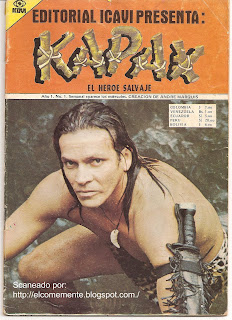
KAPAX , whose real name is Alberto Lesmes Rojas, is considered the Tarzán of Colombia. Anyone landing at the airport in Leticia will see a giant mural of him on the wall of the airport. He became famous when in 1976, at the age of 28, he swam the length of the Magdalena river -- some 1700 kilometers. It took him about 5 weeks to accomplish this goal. Why did he do this? To help draw attention to the importance of keeping the rivers of Colombia clean -- a man before his time. He started life in a small town, Puerto Leguizamo , in the department of Putumayo . At the age of 8, his father abandoned the family. As a result, he was left without the means to go to school. Lonely and bored, he then spent many hours watching black and white Tarzan movies at the local movie theater. He was fascinated. After watching the movies, he would go out into the jungles surrounding the city and practice the moves that he had seen on the big screen -- earning the nickname --Tarzan of the Amazon. For ye...

El Pirarucu de Oro -- International Folk Music Festival

Every year for three days at the end of November, the El Pirarucu de Oro festival is held in Leticia, Amazonas , Colombia. The festival takes its name, Pirarucu , from a fish found in the region that can weigh up to 150 pounds and grow over six feet long. The fish is an endangered species which has lead Colombia, Brazil and Peru to declare a ban on the catching or killing of the fish from November-March of every year. The festival takes place during the ban as a tribute not only to the music of the area, but to the fish so closely associated with sustenance in the Amazon. This year the festival is celebrating its 22 nd consecutive year. There are several categories of competition: 1- Murgas Leticianas -- People of any age can participate in this category, but the songs must reflect the music of the area of Leticia and the surrounding region. 2- Cantantes Aficionados -- In this impromptu contest, participants must sing about an assigned topic (they cannot receive help from the au...

Yurupari -- Sacred Flute

According to Javier Ocampo López , Yuruparí is the god of the indigenous Tucano peoples of Vaupés . He is the product of a pregnancy that occurred when his mother Secuy ate the forbidden fruit of pihycán . After his birth, she hid him in a hollow tree where she would go and breastfeed him several times a day. Eventually, Yuruparí grew and left the tree to seek out his mother. Apparently, he had been blessed with magical powers. His first magical act was to change all curious women into rocks. Even his mother fell victim to this as he caught her spying on the men of the village while they were in a meeting. In an attempt to obtain dominance over all the women, Yuruparí started a new religion where women were not allowed to participate. He used a flute to symbolize membership in the cult. The flute also represented the voice of God and the bones of the mythic hero of his people -- Ualri . Then, Yuruparí was burned up and left nothing but ashes -- from which grew the PACHUBA palm ...

Ancas de Rana o Pollo

I have to admit that trying to find a recipe from the Amazons that was possible to actually make outside of the Amazon has been difficult -- since access to Boas, Monkeys, Manatees, Frogs, Snails, and Turtles isn't exactly an easy task. My mother suggested that I give you the frog recipe -- and since frog tastes a lot like chicken -- you might substitute frog legs for chicken legs. The recipe: Step #1 Clean the legs and rub them with lime juice. Step #2 Fry them in oil without salt, until golden brown. Step #3 Place on a paper towel, let drain and serve. Simple, but worth a try.

Unusual Fruit -- NOT TO MISS CUISINE

Image
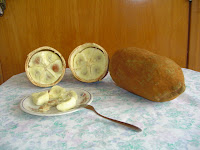
Long before I met my husband, I spent 18 months living in Toronto, Canada. Most of the people I lived and worked with were from Latin America. I remember that one of the families I knew was from Colombia. On their wall was a large poster of the many different fruits of Colombia. Dozens of fruits that seemed completely unfamiliar. I remember thinking that it would be great to try all of them. And now, having tried many of them, I must recommend that you try some too. The fruits are definitely one of the NOT TO MISS CUISINE items of Colombia. This week, with the focus on the Amazon regions of Colombia, I thought I would spotlight some of the amazing fruits of the region. Seje -- found in the Amazon and Pacific Coast regions. This fruit is most similar to a date and is the size of a marble. It is cooked before serving. Unfortunately, I could not find a picture of this fruit. Copoazu -- (Theobroma grandiflorum) -- This fruit is a relative of the cacao and its seeds can also pr...

Amazonas -- Colombia's Amazon Region

Image
In actuality the Amazon region of Colombia makes up 42% of Colombian territory, but it is the area with the lowest actual population. There are six departments that make up this region of the country: Amazonas , Caquetá , Guainí a , Guaviare , Putumayo and Vaupés . However, small parts of the departments of Narino , Cauca and Meta are included in the Amazon region as well. This region unfortunately includes some of the most dangerous parts of Colombia and is infested with FARC and other rebel groups. It was in this region that Ingrid Betancourt was held captive for so many years. It is also the region where the native indigenous cultures have been best preserved. In addition to the native populations, the large cities include 'colonists' from Colombia's interior as well as from Brasil , Ecuador, Peru and Venezuela. According to the latest national census, conducted by the DANE, the Amazonian region's city of Florencia has the largest population (121, 898), followed ...