Posts

Showing posts with the label Been There Done That

What We Wish We Would Have Known

Image
It is about time for another installment of Jane's advice for people adopting a older child. So here goes and thanks Jane: Here are a few ideas from the "Stuff we wish we would had known about before adopting an older child" file: That a summer vacation isn't real life. Some of the children who are up for adoption come as guests of a summer program. Of course children on vacation are going to have a good time with their host families. But once the vacation is over, the papers are signed and real life begins, it is a shock. Be prepared for the reality. That a child's wishes may not be in her best interests. If your child wants to change her name, that's not cute. She wants to forget the past, which is impossible. Just because you have adopted an orphan doesn't mean you have to accede to every wish. If she wants to stay up late, text boys you haven't met, watch only Spanish TV, it's OK to just say "NO!" And then explain why. You'll be ...

Bogotá for Beginners: Museo de Oro

Image
When the Spanish came to what is today Colombia, they heard a tale of a tribe of Indians that were masters of gold. Indians in the Caribbean region spoke of a tribe of Indians that made beautiful gold pieces and that had so much gold that they would paint themselves with it and sacrifice boat loads of gold to their God. Thus began the search for El Dorado (the Golden One). Though the story the Spanish heard was greatly exaggerated, there was indeed a tribe of Indians that made a sacrifice of Gold in what is called the lake of Guatavita. When the Cacique (ka -SEE-kay) of the village of Guatvita died and his successor appointed, the new chief or cacique would indeed be bathed in gold. Then, he sat upon a large wooden raft that was covered in items made of gold. He would float out into the middle of the lake and all of the items would be dumped into the lake then he would jump in and wash off the gold from his skin. The piece pictured here at the left is a representation of that cere...

Bogotá for Beginners: Museo Botero

Image
Back in December, I wrote about the artist Fernando Botero: http://raisingcolombiankids.blogspot.com/2009/12/fernando-botero.html Today, as part of the Bogotá for Beginners series, I would like to talk about the Botero Museum in Bogotá. This truly is a must see for any adoptive family. In 2000, Fernando Botero donated 123 works of art to the art museum that now bears his name. The works include drawings, paintings and sculptures. You can see online photos of the collection here: http://www.lablaa.org/blaavirtual/museobotero/listabot.htm In addition to the works by Botero, you will find other works by the following artists: Corot, Renoir, Bonnard, Dalí, Chagall, Beckmann, Delvaux, Giacometti, Picasso, Miró, Bacon and Moore. The Museum, which is FREE to the public, is located in La Candelaria, right next door to the Casa de la Moneda. The exact address is Calle 11 No. 4-41. Its hours of operation are: Monday - Saturday 9:00 a.m. - 7:00 p.m. Sundays and Holidays: 10:00 a.m. - 5:00 p.m. ...

Bogotá for Beginners: Casa de la Moneda

Image
In the heart of Bogotá, just a few steps from the Plaza de Bolivar, you will find the House of Coins --La Casa de la Moneda. Established in 1621, by the military engineer Alonso Turrillo de Yebra, who had been authorized by the King of Spain to create the first money minting facility in the New Kingdom of Granada (el Nuevo Reino de Granada). It was in a rented house, in what is known as La Candelaria, that Turrillo de Yerba began making the first gold coins in the Americas. The coins were known as doblones . The original ones made were done by hand and each looked slightly different on the edges. But by 1756, the production was mechanized and more uniform circular coins were made. In the 1960's, the Colombian government began the process of restoring the original mint and its colonial architecture. In 1982, the restored building opened to the public as a museum. There are both permanent and temporary exhibits. The exhibit that most impressed our boys was seeing a real Pirate treasu...

Bogotá for Beginners: Divercity

Image
What to do when spending endlessly long weeks in Bogotá waiting for Sentencia . If you have children ages 4 to 13, I would highly recommend spending a weekday morning at DIVERCITY . DIVERCITY is a mini city for kids inside a huge, new shopping mall in the North of the city-- the Santa Fé . Kids over 3 pay about $5 to enter (parents cost about $3). For the price of admission, they are issued a $20 divi dollar pay check. Once inside they cash the $20 check at the bank and learn how to use an ATM card. Then, they can start spending or earning money. They earn money by working at different occupations- police detectives, fire fighters, foot loop packers, coke bottlers, veterinarians , pilots, farmers, TV station announcers , Radio announcers, beauticians, insurance agents, supermarket clerks, paleontologists, architects, authors, discotheque workers, etc. They spend their divi money if they want to go on safari, watch a play, climb the rock wall, play arcade games, take bus rides, or...

Bogota for Beginners: Taxis and Transmilenio

Image
There are two ways to get around Bogota that are easiest for those who are new to the city: Taxis and Transmilenio. There is also a really extensive bus system but since there are not maps available I wouldn’t suggest it for foreigners. Transmilenio –This is a hybrid between a subway/bus system. The busses run on fixed routes that are completely separate lanes from other traffic. These routes have platform stations where you buy a ticket and wait as if waiting for a subway. Transmilenio is safe, clean and fast. According to my husband, it has dramatically changed the traffic situation in Bogota. Taxis –The easiest way to get around. Compared to taxis in the U.S., Bogota taxis are dirt-cheap. To understand how the billing works look at the taximeter at the front of the taxi. The number will correspond to a price that is listed on a laminated sheet attached to the back of the seat. This sheet should also have a picture and information about your taxi-drivers registrat...

Lechona Tolimense -- Not to Miss Cuisine

Image
When talking about the food of Tolima , there is probably nothing more Tolimense than their signature dish -- LECHONA . In fact, the production of Lechona for fiestas in Tolima dates back several centuries. It really IS what's for dinner in Tolima at just about any big celebration -- weddings, baptisms, Christmas, New Year's etc. What is Lechona ? In a few words, stuffed roasted pig. How is it made? First, you take the 50 pound pig and debone it and clean it out --making sure to leave the skin intact. Next, you take all of the ribs and meat and chop them up with an axe and add them to about 10 pounds of pork meat (cut in small chunks) and marinate ( adobar ) it all in a mixture of garlic, green onions, cumin, salt and pepper. Then, you cook the meat in lard. You also prepare rice, peas, and potatoes to add to the mixture. When all the stuffing ingredients are mixed together, you stuff the pig and then sew it up. You cover the skin with bitter orange juice and cook it all ...

Try This Reading Technique -- for all language groups

While I am working with a Speech Therapist and a member of a University's ESL Faculty to put together more suggestions that can help with the teaching of ESL to your newly adopted child, I wanted to make 1 suggestion now that can help you as you read aloud to your child. Here is the technique: (TO MY EUROPEAN READERS: I found research that shows Dutch speaking children have similar issues to those learning ESL. We might assume, therefore, that children learning other languages -- particualrly those very different from Spanish -- Norwegian, Swedish, Icelandic, Finnish, Danish, German, etc. would suffer from similar language proficiency problems. So, you can try using this technique as well). Step #1: Read the title and look at the pictures. Label pictures that your child cannot name. The talk about or predict what the story is about. Step #2: Read 1 page or 1 paragraph, then stop and ask a question about the content. Once child answers, model the correct answer in a short ...

DOES YOUR CHILD NEED ESL???

If you have a child adopted at 5, 6, or older, it is clear that they will need English as a Second Language classes at school, and most districts will help you. But what about the adopted toddler or preschooler? Most people -- and teachers -- assume that the child will adequately learn English by the time the child goes to school simply because they only hear English spoken in the home. Ah, but is that true?!?! I became aware that my own son (now 4 1/2) may be having difficulty with English acquisition when I started teaching him to read. He was/is doing great sounding out words. We started with the words that end in AT -- CAT, RAT, BAT, etc. He would look at the picture of a RAT, sound out R-A-T and then say MOUSE. I would correct him and say RAT. Then, finally one day he said, "Mommy, what is a rat?" OOPS! In addition to simple vocabulary issues, there are other issues that he has with language, so I reached back to my Master's degree in TESOL and started researching ab...

Bogotá For Beginners: Salto de Tequendama

Image
A great Saturday or Sunday afternoon excursion while staying in Bogotá is to visit the Salto de Tequendama -- mentioned on Monday. The waterfall itself is about 137 meters high and is located just 30 kilometers from Bogotá. I recommend seeing it on a weekend as the traffic in Bogotá is lighter and you will be able to get through the city's traffic easier. There are some ASADEROS at the falls where you can enjoy traditional Colombian food. We visited this place the weekend after we picked up our son. At almost 2, he loved to wander around the grounds eating arepas. Our 5 year old enjoyed the story and taking pictures. Just a cool place to say you've visited. (Update March 2010) Just got an e-mail from an adoptive family in Bogota and need to say that visiting the Falls From December - March during a drought is not a good idea. Not much of a falls. The picture is from an October visit after a rain storm.

Ráquira -- Souvenirs Galore

Image
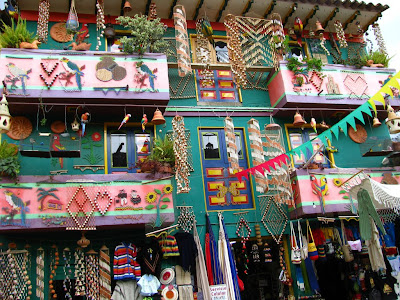
So, you want to get some GREAT SOUVENIRS. Where do you go? Yes, there is an artesan market in Bogotá, but if you want to see endless selection of ceramics, hand made pots and statues, handmade hammocks, ruanas, art, etc. You need to go to Ráquira. Ráquira is the Chibcha name meaning "City of Pots", and that is exactly what it is. Originally, an area of a small Chibcha population governed by the Cacique Suaya and under the authority of the Zaque of Hunza (Tunja), the conquistadors passed through the village on their way to Bogotá in 1537. The city of Raquirá was 'founded' in 1580 by Fray Francisco de Orjuela, on October 18. The Natives of the area were then taught Catholicism by Augustine Monks who founded the first Augustine Monestary in the Americas in 1607 just outside of Ráquira. Ráquira is an amazing place to spend a couple of hours. It is about 20-30 minutes from Villa de Leyva. Make sure to bring your wallet and be prepared to make some amazing finds in this l...

Fossils

Image
In and around Villa de Leyva, you will find hundreds of real relics -- FOSSILS. The fossils, particularly those of ammonites are so common that many of the buildings in Villa de Leyva have used them as part of the buildings themselves. In 1977, farmers in a nearby vereda (hamlet) discovered the remains of a 115 million year old Kronosaurus. It is one of the few completely intact fossil remains of this particular animal to be found -- the others are located in Australia. They built the museum around the original find. Museo -- El Fosíl The museum is located about 5.5km (2 miles) outside of Villa de Leyva, just off the main highway to Santa Sofia. Outside of the Museum, dozens of people are selling fossils they have found in the area. You can pick up 5 inch size AMMONITES for just a few dollars. Ammonites Open: Mo-Su 8am-6pm. Entrance Fee: $2.500 pesos -- about $1.30. Here is a You-Tube viedo of the museum. http://www.youtube.com/watch?v=Z0Td_58QaFY Photos: http://www.flickr.com/photo...

Villa de Leyva

Image
If you check any Traveller's Guide to Colombia, you will find Villa De Leyva high on the list of NOT TO MISS excursions. Located about 3-4 hours North of Bogotá in the Department of Boyacá , Villa de Leyva is an impressively preserved Spanish Colonial village. The buildings -- mostly over 400 years old -- are immaculately preserved , and as a result, it has been declared a United Nations World Heritage site. Villa de Leyva caters to the tourist. Every time we have visited (4 times) we hear German, French, English, Italian, Swedish and other European and Asian languages being spoken -- not to mention Spanish and Argentine accents. There are beautiful Colonial Hotels and Farms where you can stay and be pampered -- they even have SPAS. Shops with all sorts of art and artisan works line the streets. There are some amazing restaurants and bread stores!!! Even if you don't speak Spanish, check out the pictures of the hotels and farms ( fincas ) on this website -- gives the be...

Car Seat Preparation -- Been There, Done That

Image
Most people will tell you that bringing a car seat to Colombia is a waste of time -- most taxis do not even have seat belts in the back seat. This means that your child will never have been belted in to anything. Therefore, the car seat can cause a great deal of distress upon the return home. In our own case, my son freaked out! Even though I was sitting right next to him and our 5 1/2 year old was also in a car seat, he screamed for the entire 40 minute ride home from the airport. It took him months before there was not a melt down every time we went to the car. Here is the advice that I have given other adoptive parents since my own fiasco. I recommend that you take a video of a child getting into a car and then getting into the car seat, booster seat, or seat belt. It would be best if you used your own car and your child's new seat as props for the video. I would also recommend that you get a Spanish speaking friend, neighbor, or relative to narrate the action and explain, usin...

Preparation for Coming HOME -- Been There, Done That

Image
I was thrilled when our son (adopted at 22 months old) seemed to bond to us so quickly and adapt so easily. Things were going great in Colombia. So, I logically assumed that coming back to the US would be easy. WRONG! Alex went through a rough few weeks once we got home. Everything was new -- AGAIN! There were new sights and sounds and smells. So many firsts! We came back on December 26th, so IT WAS FREEZING! He had to wear a parka and boots -- lots of snow had fallen that Christmas. He had to ride in a car seat. He wasn't eating all his favorite Colombian food. Everyone was speaking English. There were also new friends and family members to meet. All of the changes, seemed to put him back quite a bit. That first week home, he had that "Deer in the Headlights" look -- a lot! He was more whiny and seemed to reject a lot of things we wanted to do for and with him. He suffered several melt downs. He constantly wandered the house -- apparently looking for someone or s...

Been There, Done That -- The Beach Ball

Image
You have your referral! Now what? What are you going to pack to keep your little one, or not so little one, engaged for hours in your hotel room? Especially when luggage space is at a premium! Might I recommend a beach ball. When we went to Colombia to pick up our almost 2 year old, we brought a SMALL beach ball. I picked it up at the 99cent store. It provided many hours of entertainment -- starting with the simple blowing up of the ball. Our son had never seen something like that before and he was mesmerized by it. There are all sorts of games that you can play with a Beach Ball, and depending on the age of your child they can be simple or complex. With our 2 year old we played simple games of toss and catch or roll. With our 5 1/2 year old, we played " keep the ball from hitting the floor", dodge ball, and soccer. Even a 9 month old friend loved pushing that ball around as she crawled. This is not to mention the benefit of being able to take it to the pool. So, from the BEE...

Older Child Socialization -- More from Jane

Here is Part #3 in our series on older child adoption from Jane -- a mom who has "Been There, Done That!" If you are considering adopting an older child, you will find Jane's posts very informative and insightful. Also, you will find a link to Jane's Foundation at the bottom. For adoptive families, it's easy to integrate a newborn or toddler into your family and friend groups. Parents rely on friendships made in play groups, nursery school, church, preschool or day care. It's up to the parents to help their children create bonds with peers; sometimes lifelong bonds. Having to socially integrate your newly adopted preteen or teen is harder. There may be some behaviors that your new family member will exhibit that may not lead to immediate friendships with kids his/her own age. Some older adopted children will have had the advantage of having been raised in a foster home. So, even though they were subjected to constant uncertainty about their future, they were...

The Perfect Family -- More thoughts from Jane

Image
Of course, there is no such thing as a perfect family! Or, to put it another way, perhaps ANY family is the perfect family for a child who has none. We know single moms who have adopted, a single dad who has two adopted siblings, and families whose adopted teens are "only children" in their new family group. However, after three years of socializing with these parents, hearing their stories and observing outcomes, John and I are in agreement about one thing: older parents who have already raised their children make pretty good adoptive parents of an older child. So my observations are those of an older mom whose biological children have flown the nest. Our older adoptive child exhibited two kinds of behavior: the universal adolescent and the "red flag". Being able to recognize the difference between the two and responding appropriately was HUGE in building our relationship with our adopted 14 year old. We had raised two biological children and sent them off into the...

Museo & Parque Arqueologico de Sogamoso

Image
If you decided to spend the night in Paipa , before heading back to Bogotá , I have another recommendation -- The Museo & Parque Arqueologico ( Archaeological Museum and Park). It is located about 40 minutes from Paipa in the city of Sun and Steel – Sogamoso . The Indiana Jones of Muisca (Chibcha) culture is Eliécer Silva Célis (1914-2007). He was the principal pioneer of archaeological research surrounding indigenous groups in Colombia, and the leading expert on the Muiscas . He made some amazing discoveries. And like Indiana, he felt that Muisca artifacts belonged in a museum. So, he spearheaded the building of a Archaeological Museum and Park in Sogamoso . Sogamoso was the religious capital of the Muiscas . Both the Zipa and the Zaque honored and worshipped there. The priest of Sogamoso had a great deal of power and on at least one occasion brokered peace between the two warring factions. Silva Celis therefore thought that Sogamoso was a logical choice for a mu...

Aguas Termales Paipa

Image
Place #3 -- Paipa Now that you have seen the amazing monuments to the Battles of Independence of Colombia, it is time to spend the afternoon either relaxing in Hot Water Springs or shopping in the numerous artesan shops of Paipa, Boyacá. Paipa is located just 15 minutes from Pantano de Vargas. It’s main attraction is its Aguas Termales (Thermal Hot Springs). The great thing is the warm mineral water. Kids love it because they don't get cold. There you can swim as a family, or split up and have Mom enjoy a few hours at the Spa. There you get an aqua massage and for a little more you can be bathed in the mud of the thermal water (supposedly it has curitive powers) – and the prices are amazing. If you decide to spend the night in Paipa, there are many wonderful hotels on the lake Sochagota, and you can enjoy shopping at the multiple artesan shops. There are also a few antique shops with some pretty amazing finds. Here is a multi-media presentation from the Paipa mayor’s office. http:...