Posts

Showing posts with the label Caribe

Wednesday's Wonders: DIABOLINES

DIABOLINES -- there is probably not a person from Sucre that has not purchased these little treats. These are delicious toasted cheese snacks that are famous in the region. Made from Tapioca flour, eggs, salty cheese, milk, salt and butter. They are worth a taste, albeit a small one if you want to watch your figure. Here is a website with a recipe. Unfortunately, it is for making a HUGE batch, and unfortunately I do not have access to salty cheese, so I did not try to reduce the amount and make it myself. But if you are interested, a libra or pound in Colombia is equal to 500 grams, not the same as a US pound. If anyone attempts this recipe, let me know how it turns out. http://diabolinescorozaleros.blogspot.com/2011/02/diabolines-corozaleros.html

Myths for Monday -- El encanto de la ciénega de Pajaral

In the Department of Sucre, you will find several swamps. Among them is the Pajaral swamp. It is known as the Enchanted Swamp. See it on a map here: http://www.indexmundi.com/z/?lat=7.3827778&lon=-73.9530556&t=l&r=280&p=cienaga_pajaral&cc=co&c=colombia In the rainy summers, the waters of the swamp become deep and turbulent. On those hot, wet summer days. Strange things have reportedly happened in the Enchanted Swamp. First, years ago, in the waters of the swamp, there would appear a giant catfish. It was so large, that to catch it became the goal of many a fisherman. In fact, men came from all over for a chance to catch the giant fish. But, no one could harpoon it. Even a well aimed harpoon would be deflected. The fish was thought to be enchanted. Next, one particular August, years ago, both a cow and a pig were seen standing in the middle of the swamp, as if they were dry land and not in the middle of a deep swamp. Finally, a man by the name of Joselito...

TUNES FOR TUESDAY -- Discos Fuentes

Image
I think we have established quite well that Fania Records greatly influenced the development and recognition of Salsa music as a genre. But, how does all this connect with Colombia? Well, that's our next topic. Bear with me because we are going to go back in time again as we search for the intersection of Salsa Music with Colombian music. This story begins in la Costa , the Colombian Caribbean coastal area, where the historic cities of Santa Marta, Barranquilla, and Cartagena are located. From these port cities, the slave trade spread the African musical influence throughout the region. Here in the Caribbean Region of Colombia, African music continued to evolve, mix, and change until it eventually spun out cumbia and vallenato among other rhythms. It was in Cartagena that Antonio Fuentes was born to his wealthy parents in 1907. In 1920, Antonio was sent to the United States to finish High School. Apparently, during a break from his studies, Antonio visited Philadelphia...

Wednesday's Wonders: Dulce de Coco

I really enjoy having a daily theme. It helps me focus :). So, I going to try Recipes on Wednesdays for a while, under the title Wednesday's Wonders. I am planning on posting a recipe from the same department that the Myth for Monday comes from. That means that today's recipes comes from the Department of Magdalena (though it is probably eaten in other parts of the Caribbean Coast as well.) Dulce de coco (Coconut Sweets) -- From Magdalena Ingredients: 1 cup sugar 1/4 cup raisins 2-3 cups shredded coconut 1 cinnamon stick 2 cups water 1/2 teaspoon lime juice Instructions: 1. Put the sugar, coconut, raisins, cinnamon, and water in a pan on low to medium heat, stirring constantly. 2. When at a low boil, add lime juice. 3. Cook until it until it starts to thicken. Then, let cool and eat.

Myths for Monday -- La Casa del Diablo

In the city of Cienaga, in the department of Magdalena (today's department), there is a fairly modern legend -- dating back to 1908 -- surrounding a man by the name of Manuel Varela. And now, La Casa del Diablo -- The House of the Devil Manuel Varela was a thin, brown, indigenous looking man, who arrived in Cienaga, Magdalena, around the middle of 1908. At the time, the town was an economic center on the Coast. This was because it was the headquarters for the multinational firm, the United Fruit Company. After his arrival, Varela quickly accumulated a great deal of wealth. This was inexplicable by the inhabitants of city, who wondered how the mysterious stranger had managed to accumulate so much wealth in such a short time. Soon, Varela's properties were so extensive that he built his own railway line to transport his bananas, something very surprising in those days. When he managed to build a mansion practically overnight, send his children to study Europe, and purchase h...

Wayúu Culture Festival

Image
Every year, on one weekend in the month of either May or June, the native Wayúu people in the department of La Guajira hold a celebration of their culture. This year the event will be held this upcoming weekend -- June 3, 4, 5. It is held mainly in Uribia -- the place that is home to the largest gathering of Wayúu in Colombia. The festival began in 1985, and in 2006 it was declared Cultural Heritage of Colombia. The event includes Wayúu: artesanías (handicrafts), food, plays, dances and competitions -- including a story telling competition.

Myths for Monday -- El Gritón -- The Screamer

Put your earmuffs on because today's noisy myth comes from the department of Córdoba. El Gritón Deep in the jungles of the department of Córdoba, there once lived a lovely indigenous woman. Unfortunately, this poor woman committed some crime (unnamed) that caused her to be expelled from her tribe. Alone, she roamed the jungle. Then, one day she was shocked to run into someone else in the jungle. The person caused her to shake in fear as a feeling of horrible terror gripped her and she froze in place. The stranger, who proceeded to attack her, was the devil himself. The result of the attack was a child -- half human, half devil. His name is El Gritón -- The Screamer. He is so named because his horrific scream pulls the trees from their roots, makes the earth shake, and causes the rivers to heave beyond their boundaries. Anyone unfortunate enough to hear the scream will also freeze in place, often losing consciousness. Upon awaking, the Gritón is gone, but the fear remains....

Cartagena

Image
I was at physical therapy last week and on the TV there I saw an Anthony Bourdain special on Cartagena. If you are in Colombia, think about taking a side trip to Cartagena. Here is a sample to get you excited:

Myths for Monday -- La Sirena Hurtado

Image
Here is a myth, just in time for the upcoming Semana Santa (Easter Holy Week). It comes to us via today's department, CESAR. La Sirena Hurtado Once, there was a beautiful, yet obstinate little girl. Born in Valledupar, she was spoiled and accustomed to always getting her way. She never listened to her parents and was rebellious and disobedient. One afternoon, she decided to go swimming in the Guatapurí river in a spot called the POZO DE HURTADO. When her mother realized what she was planning on doing, she forbid it -- after all it was JUEVES SANTO (Maundy Thrusday) and swimming would be disrespectful to the Lord, Jesus Christ. However, in her usual fashion, the girl ignored her mother and snuck out the door. When she arrived at the Pozo de Hurtado, she took off her clothing and jumped into the water from the very highest rock. When she hit the water, the sunny afternoon sky turned dark. Then, when she tried to surface, she could not. Her legs became heavier and heavier a...

Corralejas de Sincelejo

Image
This comes from my better late than never file. Last week, I forgot to post about an event that is considered an official part of Colombia's Cultural Heritage -- the Corralejas de Sincelejo. For those of you who don't know, Sincelejo is the Capital of the Department of Sucre in the Caribbean region of Colombia. However, don't let the word Caribbean confuse you. Sincelejo is NOT on the Coast. It is located in the interior of the Department on the sweltering plains of Sucre. This part of Colombia is well-known for its cattle. Which leads us nicely, to the Corralejas. The word Corraleja comes from the word Corral -- yep, the round fenced in place where you keep cattle. In this case, it is a round fenced in place with make shift bleachers for the crowd that is going to watch the main event. And what is that event, wait hold on a second, you need some more background. In most of the Spanish speaking world, a Corrida de Toros (Bullfights) is held in a nice stadium with mor...

Best Colombian Restaurants 2010

Are you interested in gourmet Colombian food? Well, I have some options for you! Last month, the Premios (Awards) La Barra, were handed out for the best restaurants in Colombia. Four restaurants from different regions of the country were recipients of the awards -- they include: Platillos Voladores -- in Cali, Valle del Cauca What to order? Chorizos picantes cocinados en guarapo con calamares fritos -- Chorizo with fried squid Address: calle 14 norte No. 9 - 32, en el famoso barrio Granada El Mezón Español -- in Pereira, Risalda What to order? Paella -- Spanish rice and seafood dish Address: calle 14 con carrera 26 La Provincia -- Medellín, Antioquia What to order? Gallina rellena con arroz de yerbas -- Chicken stuffed with herbed rice. Address: la Milla de Oro, calle 4 sur No. 48ª-179, barrio El Poblado. Londeros Sur -- Cúcuta, Norte Santander What to order? Carne a la parilla -- Colombian BBQ chicken Address: la Avenida Libertadores, sobre el malecón que da al río Pamplonita M...

San Basilio de Palenque

Here are a few other resources to learn more about San Basilio de Palenque. The Youtube piece is in English. http://www.semana.com/noticias-cultura/400-anos-independencia/137450.aspx

Consuelo Araújo Noguera

Image
Consuelo Araujo Noguera was born in Valledupar, on August 1, 1940. She was the youngest of nine children and she had to leave school at the age of 14 to work and help pay for the education of her older brothers. She would later claim that this event actually helped her to develop and independent spirit and an ability to look beyond what was typically expected of women. For over 20 years, she wrote a regular column for the newspaper El Espectador. She also had a regular program on a Valledupar radio station. She was best known as a tireless promoter of local folklore, and particularly Vallenato. In 1968, Consuelo Araujo helped to found the Festival de la Leyenda Vallenata , which takes place in Valledupar every April. Her father, Santander Araujo, was a local leader of the Liberal Party, and her political connections eventually secured her the Colombian consulship in Sevilla, Spain from 1974-78, under the Liberal presidency of Alfonso Lopez Michelsen. She was also a prominent political...

La India Catalina -- The Colombian Malinche?

Image
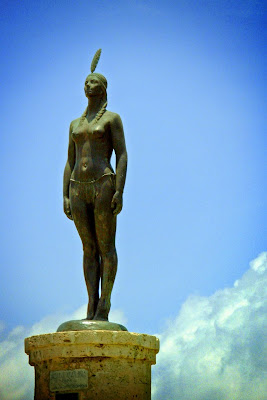
Juan de Castellanos was a 16 th century poet and priest. He was born in Spain, but spent much of his life in Cartagena and Tunja . He is most remembered for his epic poem " Elegías de Varones ilustres de Indias ", which tells the story of the Spanish conquest of what is today Colombia. There we read about the India Catalina: Una india llamada Catalina An Indian named Catalina Desde Santo Domingo se traía From Santo Domingo was brought Y era de Zamba , pueblo que confina And she was Zamba , a people that are found Con los que viven esta bahía Amongst those that live in this bay (today Galerazamba North of Cartagena ) En lengua castellana muy ladina In the Castilllian language a very smooth talker Y que la destas gentes entendía And in the (language) that these people understood La cual de esta costa presa Who from this coast was taken prisoner Siendo muchacha , Diego Nicuesa As a young girl, by Diego Nicuesa Castellanos helped to immortal...

Pedro de Heredia and Cartagena

Image
Cartagena, many know that name of the city is actually Cartagena de Indias, but did you know that the original name was San Sebastian de Calamar? Here is the story: Pedro de Heredia was born in Madrid, Spain. As a young man he was involved in a brawl that left three men dead, and he was therefore forced to leave Spain as a penance. He moved to the island of Hispañola -- Santo Domingo. There, he made friends with the right people and in 1526he was named the lieutenant governor of Santa Marta (in today Colombia), under Perdo Badillo. While in Santa Marta, he became a wealthy man by trading trinkets (bells, mirrors and hats) with the natives and receiving gold in return. He returned to Spain, and requested that he be granted permission to explore from the mouth of the Magdalena River to the Atrato River. On, June 5, 1532, he was granted his request by the sovereign of Spain. He landed in what is today the Bay of Cartagena in January 1533, and proceeded to subdue and annihilate (mostly ...

Cartagena Hay Festival

In Wales, there is an annual event which Bill Clinton called the, "Woodstock of the mind." The event is called the Hay Festival of Arts and Letters, established in 1988. Five years ago, Colombia decided to copy the idea and now sponsor the Mapfre Hay Festival in Cartagena. This year the event will be held from January 28-31. Authors from Spain, Colombia and other Spanish speaking countries will present workshop and lectures on all sorts of topics. There are even many workshops for children 8-15 years of age. If you will be in Bogota, you can catch the British author Ian McEwan, in Bogota on Wednesday, January 27th. For tickets, go here: http://www.reservasgematours.com/eventos.php?id=5&categoria=4 http://www.hayfestival.com/cartagena/en-index.aspx?skinid=5

Recipe -- Arepa de Huevo

In the department of Atlántico and Sucre and common breakfast will include this tasty treat -- Arepa de Huevo . Ingredients: 1 cup Arepa Harina 1/2 teaspoon Salt 1 - 1 1/4 cup Very Hot Water Eggs Step #1 Prepare the Arepa dough (masa). Mix the Arepa Harina with the salt and water. Mix it until it forms a dough ball. Cover and let cool. Step #2 Make small balls of dough and then put between plastic wrap and flatten them evenly into circles about 1/4 inch thick. Step #3 Place circles into hot oil until they are half cooked -- just starting to turn golden. Remove and let drain. Step #4 Cut a small hole in the side of the arepa . Drop in an egg. Close with more masa if necessary. Step #5 Drop back into the oil at let it cook until the arepa is golden brown and the egg is thoroughly cooked. There is actually a Festival of Arepa de Huevo in Luruaco , Atlántico every year during the last week of June. Here is a news report about the festival you can also see a woman prepare the ...

Cumbia -- Folkloric

Image
Monument to Cumbia in El Banco , Magdalena, Colombia CUMBIA is yet another purely Colombian musical invention. Many people are familiar with modern cumbia . Fewer are familiar with the classic folkloric Cumbia , from which modern Cumbia is derived. The classic cumbia is played using the gaita hembra , gaita macho, the maraca, and drums. Classic cumbia is a Zambo (Indigenous and African mix) invention. In fact the word Cumbia comes from the African word Cumbe which meant Fiesta or Party. Cumbia can trace its start to the beginning of the 1800s -- about the time of Bolivar. The city of El Banco , Magdalena, considers itself the birthplace of Cumbia , but Barranquilla made it famous. The Cumbia is based on a 2/2 or 2/4 time signature. Initially, the cumbia was purely instrumental. But, over time lyrics were added. In the traditional cumbia dance, the women wear long flowing skirts or dresses. The blouse has 3/4 sleeves and the bodice is tightly fit to the waist. The cloth is...

The Gaita Colombiana

Image
Gaitas are an indigenous flute of Colombia, commonly used by the Kogi , Zenu and Kuna Indians located on the Atlantic coast of Colombia. There are actually 2 different kinds of gaitas -- the male (macho) and female ( hembra ). The female has five openings and is responsible for the melody. The male gaita has only 2 openings and plays harmony. Often the person playing the male gaita will have a maraca in the other hand. The flute is made from a corazon de cardon ( a plant that is hollow when dry), beeswax, and duck feathers. Originally, the gaita was used in indigenous religious celebrations where the sound of the gaita imitated the sounds of the birds. But, with the cultural mixing of both the Spanish -- and particularly the African peoples, the sounds of the gaita have become an integral part of the culture of the Colombian Caribbean. The gaita plays a critical role in several musical genres including CUMBIA (see tomorrow's post). Watch a Gaita performance: http://...

Independence of Cartagena

Image
On November 11, 1811, the city of Cartagena de Indias , declared itself independent from Spain. It was the first city, in what is today Colombia, to do so. It was the second city in South America (Caracas was first). The city remained independent until Spain sent Pablo Morillo to retake the city in 1815. Morillo surrounded the city and used a naval blockade to prevent supplies from entering the city. After 3 months, the patriots deserted the city without surrendering. The plan was to seek foreign help and then return to retake the city. Unfortunately, the patriots boarded ships captained by traitors to their cause. Most were taken prisoner and eventually died. Some did escape and joined Bolívar in Haiti and went on to help him commence the liberation of Venezuela. When Morillo finally entered the city, he started a reign of terror. He wanted to teach the rebellious city a lesson. Many of the people of Bocachica were assassinated without trial. There were also mass executions in...