Posts

Showing posts with the label History

Orden de Boyacá -- Highest Colombian Honor

Image
The first military decoration in Colombia was created in 1819 and given to those who stood out participated in the Battle of Boyacá. This award was then forgotten for a century. Then in 1919, the government of Marco Fidel Suarez reestablished the award as a military decoration. In 1922, a decree established that the "Cruz de Boyacá" (Cross of Boyacá) could be awarded not only to military leaders, but also to foreign dignitaries. In 1930, Decree #1247, converted the Cruz de Boyacá into the "Orden de Boyacá" (Order of Boyacá). This new Orden de Boyacá could be awarded to not only the military, but also to civilians. There are several classes in the order, but in order to win the award in any class the person must have offered outstanding service to Colombia. This week it was announced that a WOMAN -- Yvonee Nicholls -- will be receiving the award at the ceremony in August. You can read about her here: http://www.eltiempo.com/gente/yvonne-nicholls-recibira-la-cruz-de...

First Afrocolombian President

Image
Long before the United States elected their first black President, Colombia had one. His name was Juan José Nieto Gil. But, if you ask most Colombians, they will have no idea who this guy is. The truth is that for reasons that historians can only attribute to racism, Colombia's only black president has been almost erased from history -- in fact, when his portrait was restored in the 1970's they changed his skin tone to white. Nieto Gil was born in what is now the department of Atlántico, on June 24, 1805. He was the son of a 1/2 black 1/2 Indian mother (a Zamba) and a Spanish father. Early on, he taught himself to read, and he became fascinated by political philosophy. In 1839, he was elected to the Provincial Chamber in Cartagena. In 1840, he participated in the War of Los Supremos (a topic for another blog), and was taken prisoner. In 1849, he started a newspaper called, La Democracia. He became governor of what was then called the Province of Cartagena in 1851. One y...

Last Minute Gift Idea: Book for Teenagers

Image
The Colombian Civil War has lasted for decades. The armed groups -- guerrilla and paramilitary and military -- have been responsible for many abuses that have often violated the human rights of ordinary Colombians. According to the United Nations, around 5,000 people lose their lives every year as a direct result of the armed conflict, and since 1985 over 3 million people have been forced to leave their homes. In 2009, this meant that Colombia had the largest number of internally displaced persons in the world -- an unfortunate and sad statistic. In 1996, the Movimiento de los Niños por la Paz -- Children's Peace Movement -- began. It started in small towns and cities as children met in round tables where they learned about and discussed their rights. This lead to a Nation Wide vote, by Colombian children, which determined the top 12 main rights that children should have. They included the right to life, the right to peace, and the right to a family that loves them. One year ...

Last Minute Gifts: P.A.R.C.E.

Amigo, Compadre , Compañero , Compinche , Colega , and Amigote are just a few words that can be used to say FRIEND in Spanish. However in Colombia, and more specifically in Antioquia and its capital Medellín , the word of choice is PARCE ( PAHR say). A PARCE is a good or close friend and the word is consistently used by most PAISAS (people from Antioquia and the surrounding coffee growing region) when referring to their friends. This is why is should come as no shock that JUANES ( a.k.a. Juan Esteban Aristizabal ), the world famous Colombian rocker and PAISA , might name his latest album P.A.R.C.E. A great stocking stuffer idea and a must for any Colombia lover's collection. http://www.amazon.com/P-R-C-Juanes/dp/B0047H7Q9U The album hit stores last week, and now that I have had a chance to hear it, I'd like to offer my opinion. First, it is a bit of a departure from his more upbeat rockero music of the past, and to me seems a little U2 ish . Though this is no...

The Face of the Tragedy -- Omayra Sánchez

There is probably not a Colombian 30 years or older that does not remember the Armero Tragedy. There is also probably not a Colombian that hasn't heard of Omayra Sánchez. Most people know her simply as Omayra. She became the face of the tragedy. She was thirteen years old the night of the eruption. She became stuck in the mud and concrete after having stopped to help others. For three days, she remained in mud and water up to her neck while rescuers tried to save her. She showed grace and dignity despite her condition and was joined by rescue workers in prayer. In the end, however, after 60 hours, she died. Her death became a symbol of the government's inaction. Here is a brief video of her:

Anniversary of the Armero Disaster

Twenty-five years ago, on November 13, 1985, Colombia experienced perhaps its greatest natural disaster -- in terms of loss of life. On that day, the Neavdo del Ruíz in the department of Tolima , came to life after 69 years in dormancy. The eruption caused the glaciers on the mountain to melt, sending massive lahars (volcanically induced mud and landslides) rushing into the valley below. The slide reached speeds of around 40 kilometers an hour. It crashed into the town of Chinchiná and Armero, killing around 23,000 people and burying the landscape in about 30 feet of mud and ash. The composition of the mud, made it impossible to use heavy machinery to help dig out survivors. Failure by the Colombia government to order the evacuation suggested by vulcanologists was cited as the cause for most of the deaths. Information was poorly distributed and the common man was not aware of the danger. The Nevado del Ruiz is still erupting on occasion. In fact, while we were in Colombia thi...

ABC Colombia

I am always on the lookout for new items for this blog. A friend recently suggested this PBS documentary -- I think it must have appeared in March of last year. It is called ABC Colombia. It is a look at a public school and village life for children in an area controlled by paramilitaries. I found it very interesting, and sad. It is just short of an hour long, so make sure to watch it when you have plenty of time. It is in English and Spanish with subtitles in English.

La Papa -- The Potato

The Conquistador Gonzálo Jiménez de Quesada wrote an account of his conquest of Nueva Granada -- what is now Colombia -- called Historia General de las Indias . Unfortunately, this record has been lost. There does remain, however, several writers from the late 1500's and early 1600's who did have access to his record and used it as a basis for their own records of the conquest of America. One of these men was Juan de Castellanos . Castellanos came to the Americas in 1545, landing in Cartagena . Eventually he became the priest of Tunja . There, using Jiménez's work as a base, he wrote his epic poem, Elegias de Varones Ilustres de Indias . The first part of which appeared in Spain in 1588. In his poem, he writes of the first encounter of the Spanish in Nueva Granada with the potato, which occurred in 1537. ... they entered into the large villages of Sorocotá , and all were deserted... even though their houses were all filled with corn, beans and truffles (to ...

Ratón Pérez -- Colombia's Tooth Fairy

Image
In a Spanish tradition, mothers would give their child's baby teeth to rodents with the belief that by doing so, their children would grow up healthy. It was from this tradition that the Ratón Pérez developed. Ratón means mouse in Spanish. Ratón Pérez is the Spanish equivalent to the Tooth Fairy. He visits little children bringing money or gifts when baby teeth are left under the pillow. The story of Ratón Pérez was changed and popularized by Father Luis Coloma who wrote a story called, of all things, Ratón Pérez. You can read the story, in Spanish, here: http://cvc.cervantes.es/actcult/raton/default.htm In our house, the kids have enjoyed the following book, which helps to integrate both cultures when a tooth is lost. You can pick it up at Amazon for less than $11 US and there is potential free super saving shipping :)

One Family's Return Trip: Goodbye Bogotá, Hello Valle

Image
We arrived in Cali at about 7 am, and fortunately for me the day was cool. (I was wearing a sweater a real rarity in Cali). We were met by my Brother-in-law whom we haven't seen for many years -- tears all around. With luggage safely stored in his trunk, we were off to see the sights. One of the mandatory tourist sites of Cali is the statue of Sebastián Belalcázar which overlooks the city. And on the day that we arrived in Cali, this group of tourists was no exception. My Brother-in-law took us to see this and other sites in Cali straightaway. Belalcazar was one of the original Conquistadores of Colombia. Born Sebastián Moyano in about 1480. He was left an orphan and raised by his brother. He later chose to take as his last name the name of the city near where he had grown up. How he arrived in the Americas is disputed. Some say he came with Colombus on his third trip in 1498. Others believe he came with Pedrarias Dávila, and then went on to explore the Darién with Vasco Balboa. W...

One Family's Return Trip: Plaza Bolívar North Side

Image
A quote from Colombian Founding Father, Fransico de Paula Santander, is what greets you at the front of the PALACIO DE JUSTICIA (PALACE OF JUSTICE). It reads: "Colombianos las armas os han dado la independencia, las leyes os darán la libertad" (Colombians arms have given you independence, laws will give you freedom!) However, the site of Colombian Justice has a relatively short and tragic history. In it's short history, there has actually been three different buildings that have occupied the spot. The first was built in the 1920's. It stood until the Bogotazo of 1948. The story of the Bogotazo should really be a blog of it's own, and it will have to be. But, here is the condensed version. On April 9, 1948, a political candidate -- Jorge Eliecer Gaitán -- was assassinated. This led to protests, violence, repression, disorder, and the start of a period known as La Violencia in Colombia. In Bogotá, one of the acts of defiance on April 9 was the burning of the P...

One Family's Return Trip: Plaza Bolívar East Side

Image
The Plaza de Bolívar is the center of the original city, and like the Washington Mall, connects the centers of government. This year it celebrated 472 years as the city center, though its current form was built in 1959-60, when it was decided that it was best not to have the city center be a parking lot. EAST SIDE The Plaza is surrounded by beautiful historic buildings. On the East is the Catedral Primada , originally built out of mud with a straw roof in 1538. The Cathedral has actually been rebuilt or remodeled several times. The most recent remodel was in 1823 following an earthquake. The Cathedral houses the remains of the Spanish Conquistador, Gonzálo Jiménez de Quesada , as well as those of Antonio Nariño . (Read about him here: http://raisingcolombiankids.blogspot.com/2009/07/antonio-narino-y-alvarez.html ) It also houses a large collection books and records that date back to 1612. Next to the Catedral Primada is the Capilla del Sagrario . Begun in 1660 and finished in...

One Family's Return Trip: Afrocolombian Hero

Image
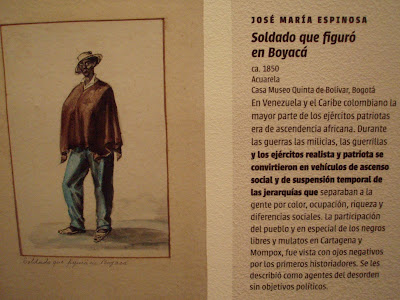
Colombian Law #70 passed on August 27, 1993. Law #70 is also called the “Law of the Black Communities”. It is considered one of the greatest achievements of the Afro-Colombian civil rights movement. Read more here: http://raisingcolombiankids.blogspot.com/2009/08/anniversary-of-law-70-celebrating-16.html Since today is the anniversary of the passing of this law, I thought I'd share what we learned yesterday at the Museo Nacional about the role of Afrocolombians in Colombian Independence. Here is a translation: In Venezuela and the Colombian Caribbean region, the majority of the patriot army was of African descent. During the wars, the militias, the guerrillas, and the armies (both royalist and patriot) became vehicles for social climbing and the temporary suspension of hierarchies that separated the people by their race, occupations, affluence and social differences. The participation of the people, and particularly the free blacks and mulattoes (mixed race) peoples in Cartagena...

One Family´s Return Trip: Pantano de Vargas

Image
Pantano de Vargas is the site of a decisive battle for Bolivar´s troops. It is also where the Lanceros became famous. At one point in the battle, Bolivar lamented aloud that he was feeling that all was lost. Juan Jose Rondón reproached Bolivar saying, ¨How can you say all is lost, if my men have not yet fought?¨ Bolivar turned to Rondón and said, ¨Coronel, Salve usted la Patria!¨ (You go save the country). Rondon took his cavalry of 14 lance carrying men, and did just that. Read a bit more of the story here: http://raisingcolombiankids.blogspot.com/2009/03/pantano-de-vargas.html Only one lancero lost his life, Inocencio Chincá. Today, many military high schools and the School for army subofficals are named in his honor. Also, the Colombian Special Forces Commandos are called Lanceros. Very few soldiers are invited to attend the Lancero school, and even fewer ever graduate. One of the tests that soldiers aspiring to be Lanceros are forced to complete is to be dropped in the jungl...

One Family´s Return Trip: Museo Arqueológico

Image
One of the places we always visit when we come to Colombia is the Museo Arqueológico in Sogamoso, Boyacá. The Museum is about 3 hours North of Bogotá on a safe road. It was established to house the remnants of the Musica/Chibcha culture. The Chibchas were the indigenous group that lived on the Altiplano Cundiboyacense prior to the Spanish arrival. The museum has rebuilt the original ceremonial center of the town, including the Temple of the Sun. There are numerous displays including several mummies (boys seem to really like those), pottery, weapons, shrunken heads, and even skulls. They show how the Chibcha skull is quite different from your typical skull. Most of us have 3 bones that grown together after birth. Chibcha skulls have 4, 5, or even 6 bones that grown together. Pretty cool! The area is actually an archeological site that is still under investigation. At certain times you can see archeology students from the UPTC (Universidad Pedogogica y Tecnologica de Colombia) working o...

One Family´s Return Trip: Monumento a Pedro Pascasio Martínez

Image
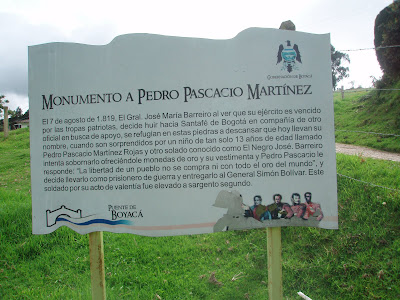
In researching my husband´s family history we discovered that he is a distant relative of a famous Colombian hero -- Pedro Pascasio Martínez Rojas. Please take a moment to read this post that I wrote about this child hero: http://raisingcolombiankids.blogspot.com/2009/08/pedro-pascasio-child-hero-with.html This is our family paying homage to our famous ancestor. This monument is located about 1/4 mile off the main road. If you are coming from Bogotá, you will turn onto a dirt road to your right. The road is just a bit before you get to Puente Boyacá. So, you can visit it first.

One Family´s Return Trip: Puente Boyacá

Image
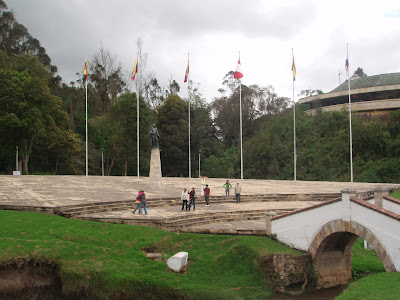
A few weeks ago, I mentioned that it is Colombia´s Bicentennial. We have been excited to teach our little guys about Colombian Independence, so right after we celebrated the Fourth of July, we began a discussion about Colombia´s Independence. Part of the learning process included plans to visit several important historical sites. One of the most important is Puente Boyacá. Puente Boyacá is located about 1 1/2 - 2 hours North of Bogotá. The road in most places is a divided highway and travel there is easy and safe. This is the site of the final battle where Simon Bolivar won independence for what is today Colombia -- the equivalent to Yorktown in the US. To learn more about this battle, read my post here: http://raisingcolombiankids.blogspot.com/2009/08/battle-of-boyaca-preparing-for-august.html The day we stopped, we were fortunate to see Colombian soliders practicing for the July 20th and August 7th celebrations. They were dressed in the uniforms of the time. It was cool to s...

Bicentennial of Colombian Indepenence: Timeline & Pictures

I know that many of my readers are homeschooling and have children adopted from Colombia. I have gotten e-mail from you requesting information about Colombian Independence and History, so that you can prepare lessons for your kiddos. Here are 9 resources for you. The sites are in Spanish. Here are a few great resources: #1 -- Colombian Independence in Pictures: http://www.mincultura.gov.co/bicentenario/?page_id=1316 #2 -- Colombian Independence Timeline: http://www.mincultura.gov.co/bicentenario/?page_id=963 #3 -- Musical Memories of the Independence http://www.mincultura.gov.co/bicentenario/?page_id=1584 #4 -- Anecdotes from Colombian History: http://www.bicentenarioindependencia.gov.co/anecdotas/Paginas/anecdotas_serie1-1a.html #5 -- FACEBOOK & Twitter friends: The Colombian government has set up 3 facebook accounts for people to learn more about Simon Bolivar, Manuela Saenz , and Santander . One twitter account for Antonio Nariño . These historical figures "post about th...

Bicentennial of Colombian Independence

Image
One of the pluses of heading to Colombia this summer is that the country is in high gear in celebration of its 200 th anniversary of Independence. I want my boys to remember Colombia's Bicentennial the way I remember America's Bicentennial in 1976. I was the same age as my Little Colombianito the year my country celebrated its Bicentennial. For years, I had a Bicentennial quarter and 7-up bottle in my room. Not sure what trinkets we will pick up for the boys, but I want it to be memorable for them. For those of you who are not familiar with the story of Colombian Independence, here is a recap: The first movement for Independence from Spain which began in what is now Colombia on the 20 th of July 1810. On that day, a group of citizens known as Criollos (those of Spanish descent born in the Americas rather than in Spain), went to Don José González Llorente ´s home ( Llorante was a Spaniard) on the pretext of borrowing a flower vase for a dinner that was to honor the Roya...

Benkos Bioho and the Cimarrones

When the Spanish began to bring slaves from Africa to Colombia, there were some who escaped and began to form free, outlaw communities. These escaped slaves were called Cimarrones , and their communities and their enclaves were known as Palenques . Benkos (called Domingo by the Spanish) Bioho is the most famous of all Cimarrones. He arrived in Cartagena de Indias in 1599, where he became the slave of Juan Gómez. The historian Fray Pedro Simón (1574-1628) wrote Benkos Bioho's story in his epic work. According to Simón, the mistreatment of slaves by Gómez led Bioho to rebel and flee his master taking with him his wife, three other men and three other women. He also encouraged an additional 22 slaves, owned by Juan de Palacios, to rebel and flee with them. The group of 30 headed out into the swamps and camped near the village of Tolú -- around 50 miles away. From there, Bioho organized the group into a guerrilla type movement, and for five years the group launched attacks on Spanish i...