Posts

Showing posts with the label Indigenous Peoples

Myths for Monday: Man's Arrival to Earth

The Indigenous people known as the Barí (also known as the Motilones) live on the boarder between Colombia and Venezuela on the Catatumbo river in the Department of Norte Santander. There are just over 3,000 members of the tribe. For nearly 400 years, they managed to resist colonization. Then in the 20th century, oil companies began to drill for petroleum on their lands. As a result, roads were built into the area and people began to move into the region. The reaction of the indigenous peoples was violent and there were many violent confrontations up through the 1960's. In an attempt to help pacify the Indians, missionaries in the area intensified their work and eventually the violence subsided. Today's myth comes to us from the Barí -- and you science fiction fans will love this one. Sent From Another Planet The ancestors say that the Barí originally inhabited another planet. Unfortunately, they were not good stewards of that planet. They destroyed it through deforesta...

Wayúu Culture Festival

Image
Every year, on one weekend in the month of either May or June, the native Wayúu people in the department of La Guajira hold a celebration of their culture. This year the event will be held this upcoming weekend -- June 3, 4, 5. It is held mainly in Uribia -- the place that is home to the largest gathering of Wayúu in Colombia. The festival began in 1985, and in 2006 it was declared Cultural Heritage of Colombia. The event includes Wayúu: artesanías (handicrafts), food, plays, dances and competitions -- including a story telling competition.

Myths for Monday -- Nukak Makú and Idn Kamni

Today's myth takes us to the department of Guaviare. There, between the Guaviare and Inírida rivers live a small group of Indigenous people called the Nukak Makú. This group of nomadic hunter-gatherers had been "uncontacted" by white man until 1988. However, since their discovery, their population has been decimated by disease and the armed conflict in Colombia, having lost approximately half of their population. In 1993, Colombia set apart land as a Nukak Makú reservation and expanded it in 1997. Approximately 1/2 of the now living Nukak Makú live on the reservation, where they have been victims of FARC violence. The other 1/2 wishing to flee that violence have moved to the department's capital -- San José de Guaviare -- where the government has established small settlements -- think refugee camps. (See a photo essay of those camps here: http://www.jansochor.com/photo-essay/nukak-maku.html ) Here is the Nukak Makú origin myth: Idn Kamni According to the Nuk...

Myths for Monday -- El Burrito y La Tuna -- The Donkey and the Prickly Pear

Last week, I posted about los Wayuú (or Guajiros), the Indigenous people of La Guajira (today's Department of Focus). Today, I want to share one of their myths. But first, it would be important to explain that in the native religion, the Wayuú believe in many Gods. Maleiwa is the beneficient God. While Wanulu is the the evil God, the enemy of mankind. And now, without further ado..... El Burrito y La Tuna One day, a Wayuú man was travelling the countryside of La Guajira atop his donkey. After many long hours of walking in the hot sun, the two stopped to rest for the evening. The man hung his hammock in the trees, and quickly fell asleep. However, in the middle of the night, he awoke to the hair-raising sound of the whistle of Wanulu. Terrified, he jumped from his hammock and ran behind the trees. His donkey, however, did not move. It was as if he had not heard the Wanulu. Then, the Wanulu appeared before him. "Where is your rider?" he demanded. "I do...

Los Wayuú of La Guajira

The Department of La Guajira, with its capital Rioahcha, is located on the Northern most peninsula of Colombia. It is an arid, desert region. It is hot and dry! The area is home to several indigenous groups among them are the Wayuú (also sometimes referred to as the Guajiro). The approximately 144,000 Wayuú are divided into matriarchal clans -- each clan consisting of several families, all with a common ancestor. These clans often fight with each other. They live in small groupings of huts -- called Caseríos -- which are located far from each other to avoid the mixing of animal herds. The Wayuú believe that there is life after death. This life is somehow related to the bones of the deceased. Therefore, great care and ceremony accompany the burial. After 2 years, the bones of the deceased are exhumed and placed in a pot which is then reburied. In Manaure, the Wayuú mine salt, which they have done since before the coming of the Spanish. Here is an interesting look into the G...

Myths for Monday -- How Death Came to Earth

Curripaco (aslo called Kuripaco, Kurripaco, Koripako, Waquenia, Karrupaku) is an Arawakan language spoken by 7,830 people (in 2001) in the departments of GUAINIA (today's department), Vaupes, & Vichada, Colombia. The are approximately 5,000 other Curripaco Indians in Brazil and Venezuela. Their culture has been largely lost as they have been taught by Evangelical Christains. However, one of their myths has been recorded and preserved. It tells of how DEATH was brought to the world. Ñapiríkuli was walking over the hills of Guainía, when he ran into a woman with her child. The child's name was Kuwai. Unfortunately, soon after, the child died. But Ñapiríkuli did not want to let death enter the world. So, he placed Kuwai in a room and told the mother to be at peace. "Nothing will happen to your son, in 3 days he will walk out of this room alive." Ñapiríkuli then told the woman that the door to the room needed to remain closed for the duration of the three d...

Myths for Monday -- The Paez Version of Creation

Image
The PAEZ Indians of Colombia, also known as the NASA , are found in an area called Tierradentro in the Department of Cauca (today's department) and Huila. Based on their total population, they are the second largest indigenous group in Colombia with a little less than 140,000 people. In 1536, the Spanish conquistador, Sebastian del Belalcazar, tried to subdue the Paez Indians, but to no avail. Later, Belalcazar ordered the construction of a city -- San Vicente de Paez, right in the heart of Tierradentro. However, in short order, the Paez had destroyed the city. Belalcazar was reported to have said, "What we don't win with our weapons, we will win with our priests!" Indeed, the next weapon tried to pacify the Paez was the Catholic religion. However, this tactic was also unsuccessful. One priest reported, "The Paeces are the most barbarian of any people found in these new lands. They resist everything....They laugh out loud when they are taught (the catech...

Carnaval de los Indigenas -- Sibundoy, Putumayo

This weekend there is a special celebration to be held in Sibundoy, Putumayo, one that will be declared part of Colombia's national cultural heritage this next year. It is known as the Carnaval del Perdon (Indigenous Carnaval of Forgiveness). The Carnaval includes a parade where the leaders of the tribe are dressed in the traditional poncho called the kusma (or cusma), black pants (traditional) or jeans (modern) and a crown of feathers. The women are dressed in a skirt and blouse made of linen, dyed with a seed called the curiguasca . The blouse is tied at the waist with a large band of colors. All of these clothing items are hand woven by the Kamsá. They, both the men and the women, will also wear numerous necklaces of bright vibrant colors, called chaquiras . Some will also paint their faces with red dots or lines. The parade will also include music made from traditional pan flutes and other instruments, as well as sightings of some of the famous wooden masks made in th...

Kamsá Indigenous People

In the valley of Sibundoy (located between 10,000 and 11,000 ft above sea level), in the Northwestern department of Putumayo, live the indigenous group known as the Kamsá --(or Kamenstá, Sibundoy). The language spoken by this group is also known as Kamsá, and is known as an language isolate -- meaning that it is unrelated to any other known language. In 1980, it was estimated that the population was around 4,700 people. The Kamsá engage in trade and training with several Indian tribes from the lower, jungle regions of Putumayo -- Kofán, Coreguaje & Inga. The training consists of the training of their shaman (religious/medical leaders), who learn to use medicinal plants and religious ceremonial plants like the hallucinogenic plant yagé. They cultivate corn, beans, potatoes, and peas. See a picture of the Kamsá here: http://www.flickr.com/photos/59595049@N00/211037012/ Online I found the following list of Kamsá words: English/Français/Español.......... Kamsá One/Un/Uno ............

When Cultures Collide

Two years ago, a scene played out at a hospital in Quibdó, Chocó, which has repeated itself many times over the years. Here is what happened. An indigenous woman entered the hospital with a sick baby. Once the baby was being taken care of, the mother got up and in broken Spanish stated, "I no want baby. I no want baby." The baby had down's syndrome and was suffering from malnutrition. An article in the Colombian weekly magazine, SEMANA, reports that this scene is more common than one would like to admit. According to the author, in several of the Indigenous groups of Colombia there is a belief that having a child with any kind of deformity, a cleft lip, crossed eyes, missing limb or digit, mental retardation, etc. is a punishment of the Gods -- one which they cannot accept. They discontinue feeding the child and, without intervention, it will starve. In other past cases, prior to ICBF intervention and education, children were simply smothered at birth. Now, ICB...

La India Catalina -- The Colombian Malinche?

Image
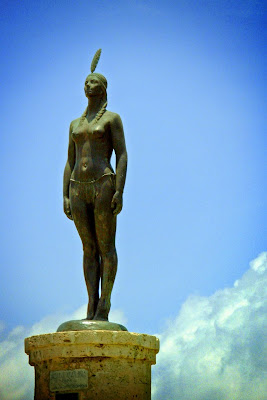
Juan de Castellanos was a 16 th century poet and priest. He was born in Spain, but spent much of his life in Cartagena and Tunja . He is most remembered for his epic poem " Elegías de Varones ilustres de Indias ", which tells the story of the Spanish conquest of what is today Colombia. There we read about the India Catalina: Una india llamada Catalina An Indian named Catalina Desde Santo Domingo se traía From Santo Domingo was brought Y era de Zamba , pueblo que confina And she was Zamba , a people that are found Con los que viven esta bahía Amongst those that live in this bay (today Galerazamba North of Cartagena ) En lengua castellana muy ladina In the Castilllian language a very smooth talker Y que la destas gentes entendía And in the (language) that these people understood La cual de esta costa presa Who from this coast was taken prisoner Siendo muchacha , Diego Nicuesa As a young girl, by Diego Nicuesa Castellanos helped to immortal...

Indians in Colombia

Back in the early 1990s, when I was a university student, I spent almost 6 months living and working in rural México . One thing I learned from the people I lived with was the great pride that they have in their indigenous roots. Families proudly name their children after famous indigenous people or simply give them indigenous names -- I think just about every family has a Cuauhtemoc or Xochi or Quetzal . Unfortunately, Colombians don't really have that same love for their indigenous roots. I was reminded of this in a recent article I read. The article featured a photographer from Bogotá , Santiago Harker , who has just recently published a coffee table book about a fishing community of Wayuu Indians -- Apalaanchi , pescadores wayuu . In the article he states, "We are a country without memories and we do not feel pride about our indigenous origins.....We have no pride because we are ignorant. I hope more photographers and anthropologists will decide to study these communit...

Bogotá for Beginners: Museo de Oro

Image
When the Spanish came to what is today Colombia, they heard a tale of a tribe of Indians that were masters of gold. Indians in the Caribbean region spoke of a tribe of Indians that made beautiful gold pieces and that had so much gold that they would paint themselves with it and sacrifice boat loads of gold to their God. Thus began the search for El Dorado (the Golden One). Though the story the Spanish heard was greatly exaggerated, there was indeed a tribe of Indians that made a sacrifice of Gold in what is called the lake of Guatavita. When the Cacique (ka -SEE-kay) of the village of Guatvita died and his successor appointed, the new chief or cacique would indeed be bathed in gold. Then, he sat upon a large wooden raft that was covered in items made of gold. He would float out into the middle of the lake and all of the items would be dumped into the lake then he would jump in and wash off the gold from his skin. The piece pictured here at the left is a representation of that cere...

Bogotá for Beginners: Museo Nacional de Colombia

Image
In the U.S., we have the Smithsonian. In Colombia, there is the Museo Nacional -- the National Museum. The Museum was established almost 187 years ago -- on July 28, 1823. It thas been housed in many locations, but the most recent (from 1948 - the present) is the former Cundinamarca Prison -- which was declared a National Monument in 1975 because of its amazing architecture. A few years ago, a newly restored and updated interior was unveiled. What a change!!! Today the museum boasts permanent and travelling exhibits on 3 different levels. The permanent exhibits consists of 17 areas and over 2,500 pieces. The first floor houses the Pre-Colombian exhibits as well as exhibits from the time of the Spanish Conquest. Gold, pots, mummies, swords -- way cool for little boys!!! You can learn about native Colombians from many different regions -- Tolima, Boyacá, the Coast, etc. The 2nd floor houses exhibits from 1550-1886 -- the Colonization, Independence (including items belonging to Simón Bo...

La Voragine -- The Vortex

Two weeks ago, I received an e-mail from an adoptive mother with a great question. "My teenage son was adopted from Colombia. I would like for him to know more about Colombia and be able to relate to other Colombians his age. Could you tell me what books Colombians read during high school and if there are English translations for the books?" I thought it was a great idea. So, here is the first suggestion -- which just happens to relate to yesterday's post. In 1924, Jose Eustasio Rivera wrote a book called "La Voragine," in English -- The Vortex. The story is about the rubber barons and their mistreatment of the Indigenous population of the Amazon. It is written in the 1st person is almost an autobiographical way. It is the story of Arturo Cova and Alicia (his love interest) and how they elope from Bogota for the Eastern jungle. It relates their experiences with the rubber barons and the massacre of San Fernando. I confess that this is not a book that I hav...

How Rubber Destroyed the Indian Communities in Colombia

The story of the indigenous groups of the Amazon is one of both sadness and hope. Sadness because the rubber trade caused the loss of 80% of the Indigenous population of the Amazon region. Entire tribes were wiped out. People were uprooted and transplanted and much of the native life and culture were lost. However, there remains hope. This hope exists because many tribes, though greatly reduced in number, have survived. They have maintained their language and have recovered their culture and their traditions. Colombia recognizes the importance of saving these tribes. But rather than talk about the present, let's look at how rubber exploitation almost destroyed the Indians of the Amazon. It all began in the late 1880's when the Peruvian, Julio Cesar Arana, started a rubber-collecting business known as Casa Arana -- later called the Peruvian Amazon Company. The company, with its main office in Iquitos, made him a multi-millionaire at the expense of the Indigenous popul...

Bora Indians

Image
The Boras of the Amazon live in Peru, Colombia and Brazil, with approximately 1000 Boras Indians living in Colombia. They have divided themselves into different clans, in which each clan represented by a different animal. Each clan paints the design of their clan on their face using huito dye. People are not allowed to marry within their clan. The Bora live, like the Yagua, in large communal houses called Malocas. The Maloca is shaped as an octagon and has three openings. It is said to be the representation of the universe. Their traditional clothing is made from tree bark and is course -- like burlap. Typically women do not wear anything on top. The Boras are survivors. Despite their horrible treatment as slaves by rubber plantations in the early 1900's, they have managed to bounce back and are fervently trying to maintain their language and culture. You can learn more about the enslavement of indigenous peoples of the Amazon in the book: The Putumayo, the Devil's Parad...

Yaguas

Image
The Yaguas indigenous group live in the Amazon regions of Colombia, Brazil and Peru. There are approximately 300 of them in Colombia, and they live on two reservations -- Santa Sofia and El Progreso. They do not call themselves Yaguas, but rather Nihamwo -- which means 'the people'. The typical attire of the Yaguas is made of palm fiber and looks like a grass skirt. In fact, when the Spanish first came across the Yaguas, they saw people wearing grass skirts and carrying blowguns in the trees lining the Amazon river. Because they wore skirts, they assumed that they were women and named the river Amazon after the mythical Greek women warriors. The Yaguas live in houses with large family groups (usually consisting of up to 10 families). The large home has 2 doors and a conical shaped roof covered in palm leaves. Inside, the home is sparse with many hammocks hung from the roof supports. In addition to the homes, villages will have several small huts that serve as kitchens...

El Pirarucu de Oro -- International Folk Music Festival

Every year for three days at the end of November, the El Pirarucu de Oro festival is held in Leticia, Amazonas , Colombia. The festival takes its name, Pirarucu , from a fish found in the region that can weigh up to 150 pounds and grow over six feet long. The fish is an endangered species which has lead Colombia, Brazil and Peru to declare a ban on the catching or killing of the fish from November-March of every year. The festival takes place during the ban as a tribute not only to the music of the area, but to the fish so closely associated with sustenance in the Amazon. This year the festival is celebrating its 22 nd consecutive year. There are several categories of competition: 1- Murgas Leticianas -- People of any age can participate in this category, but the songs must reflect the music of the area of Leticia and the surrounding region. 2- Cantantes Aficionados -- In this impromptu contest, participants must sing about an assigned topic (they cannot receive help from the au...

Yurupari -- Sacred Flute

According to Javier Ocampo López , Yuruparí is the god of the indigenous Tucano peoples of Vaupés . He is the product of a pregnancy that occurred when his mother Secuy ate the forbidden fruit of pihycán . After his birth, she hid him in a hollow tree where she would go and breastfeed him several times a day. Eventually, Yuruparí grew and left the tree to seek out his mother. Apparently, he had been blessed with magical powers. His first magical act was to change all curious women into rocks. Even his mother fell victim to this as he caught her spying on the men of the village while they were in a meeting. In an attempt to obtain dominance over all the women, Yuruparí started a new religion where women were not allowed to participate. He used a flute to symbolize membership in the cult. The flute also represented the voice of God and the bones of the mythic hero of his people -- Ualri . Then, Yuruparí was burned up and left nothing but ashes -- from which grew the PACHUBA palm ...