Posts

Showing posts with the label Art

Your Vote Counts -- SAVE COLOMBIAN NATIVE ARTS

Image
You can do your part in saving Colombian native arts. Watch this: Here are the 10 techniques you can vote for: #1. los Peyones (Weavings) of the Indigenous Wayuú from La Guajira #2. los Tejidos de Algodón (Textiles) from Charalá, Santander #3. la Alfarería (Ceramics) from Ráquira, Boyacá #4. la Sombrerería (Hat making) from Ancuyá, Nariño #5. la Marimba (Marimba) from Guapi, Cauca #6. las Alpargatas (Sandals) from Guacamayas, Boyacá #7. la Talla en Madera (Wood working) from the Amazons #8. la Cestería (Basketmaking) from Tinjacá, Boyacá #9. la Cestería (Basketmaking) from Indigenous Peoples of Nariño & Cauca #10. la Filigrana (Knitting with Gold and Silver) from Chocó You wanna know how I'm going to vote? See this past post: http://raisingcolombiankids.blogspot.com/2009/08/tia-isabel-our-famous-potter-of.html Now you go vote, http://www.orgulloperdidoclubcolombia.com/

One Family's Return Trip: Plaza Bolívar East Side

Image
The Plaza de Bolívar is the center of the original city, and like the Washington Mall, connects the centers of government. This year it celebrated 472 years as the city center, though its current form was built in 1959-60, when it was decided that it was best not to have the city center be a parking lot. EAST SIDE The Plaza is surrounded by beautiful historic buildings. On the East is the Catedral Primada , originally built out of mud with a straw roof in 1538. The Cathedral has actually been rebuilt or remodeled several times. The most recent remodel was in 1823 following an earthquake. The Cathedral houses the remains of the Spanish Conquistador, Gonzálo Jiménez de Quesada , as well as those of Antonio Nariño . (Read about him here: http://raisingcolombiankids.blogspot.com/2009/07/antonio-narino-y-alvarez.html ) It also houses a large collection books and records that date back to 1612. Next to the Catedral Primada is the Capilla del Sagrario . Begun in 1660 and finished in...

One Family´s Return Trip: Tía Isabel

Image
Most Colombians probably wouldn´t claim their relatives that live on remote mountain sides, but we love to visit Tía Isabel and Tío Castro. It is like going back in time 100 years. This time the boys learned to milk cows. And cut grass with machetes. In Colombia, having Indian ancestry isn´t exactly something to brag about. But, after tracing my husband´s roots back 8 generations (and sometimes up to 10 generations), we have made the discovery that he has Indian ancestry. He is, in fact, part Chibcha. Even if we hadn´t have found proof, we might have suspected it based on this father´s family tradition of pot making, that somewhere back there someone was an Indian who practiced the traditional art of pot making. Read more about Tía Isabel and her world famous pots here: http://raisingcolombiankids.blogspot.com/2009/08/tia-isabel-our-famous-potter-of.html

Oldest Film Festival in Latin America

Yesterday, the Cartagena Film Festival ( Festival de Cine de Cartagena ) began. This year organizers are celebrating the 50 th anniversary of the Festival, which makes it the oldest continuous festival of its kind in Latin America. * In the 1960's, the Festival was in competition with the festival in Havana. In the 1970's, it hosted many up and coming names and faces. The 1980's proved to be its Golden Years. Unfortunately, the 1990's brought decline to the event and up until 2 years ago, the Festival seemed to be on its last legs, losing prestige to other international and Latino film festivals. Skeptics and critics alike had all but written of the event. However, new leadership is bringing about a change. The movies being shown are now award contenders. Additionally, many homegrown Colombian movies are getting a showing at the Festival. You can read about one here: http://www.eltiempo.com/vidadehoy/ARTICULO-WEB-PLANTILLA_NOTA_INTERIOR-7300044.html For more...

Bogotá for Beginners: Museo de Oro

Image
When the Spanish came to what is today Colombia, they heard a tale of a tribe of Indians that were masters of gold. Indians in the Caribbean region spoke of a tribe of Indians that made beautiful gold pieces and that had so much gold that they would paint themselves with it and sacrifice boat loads of gold to their God. Thus began the search for El Dorado (the Golden One). Though the story the Spanish heard was greatly exaggerated, there was indeed a tribe of Indians that made a sacrifice of Gold in what is called the lake of Guatavita. When the Cacique (ka -SEE-kay) of the village of Guatvita died and his successor appointed, the new chief or cacique would indeed be bathed in gold. Then, he sat upon a large wooden raft that was covered in items made of gold. He would float out into the middle of the lake and all of the items would be dumped into the lake then he would jump in and wash off the gold from his skin. The piece pictured here at the left is a representation of that cere...

Bogotá for Beginners: Museo Botero

Image
Back in December, I wrote about the artist Fernando Botero: http://raisingcolombiankids.blogspot.com/2009/12/fernando-botero.html Today, as part of the Bogotá for Beginners series, I would like to talk about the Botero Museum in Bogotá. This truly is a must see for any adoptive family. In 2000, Fernando Botero donated 123 works of art to the art museum that now bears his name. The works include drawings, paintings and sculptures. You can see online photos of the collection here: http://www.lablaa.org/blaavirtual/museobotero/listabot.htm In addition to the works by Botero, you will find other works by the following artists: Corot, Renoir, Bonnard, Dalí, Chagall, Beckmann, Delvaux, Giacometti, Picasso, Miró, Bacon and Moore. The Museum, which is FREE to the public, is located in La Candelaria, right next door to the Casa de la Moneda. The exact address is Calle 11 No. 4-41. Its hours of operation are: Monday - Saturday 9:00 a.m. - 7:00 p.m. Sundays and Holidays: 10:00 a.m. - 5:00 p.m. ...

What is a Trova?

The Feria de Manizales features a Trova contest (the 2nd most important Trova competition in Colombia) -- but what exactly is a Trova ? A trova is a simple rhyming song that is used to express personal experiences that are often considered a subtle form of political or cultural commentary. Where did the Trova come from? Originally, the trovas were songs sung by jugglers in the Middle Ages. The concept arrived in Spain from France and then in Latin America via Spain. And while Trovas are sung in other parts of Latin America -- Cuba, Mexico, Peru. Colombia, and in particular the Paisas of Antioquia and the Coffee growing region, have made it a cultural competition. What is a Trova competition? In order to take this art form to the "next level," Pasias have made the trova an improvisational competition. The participants -- trovadores -- must seamlessly link one singer's idea to the next singer's idea while rhyming (typically a, b, b, a or a, b, a, b) and often playing th...

Fernando Botero

Image
Fernando Botero, originally from Medellin, is perhaps the most famous Colombian artist. In fact, he calls himself the " most Colombian of Colombian artists." He started out as a painter and has become famous not only for his paintings, but also his sculptures. His art was originally recognized in 1952, when he won the Ninth "Salon de Artistas Colombianos". Then, he left for Europe. Studying art for a time in Spain and then in Italy. He struggled to find his voice, so to speak, for several years and eventually ended up in New York in 1960. There his art was recognized and awarded the Guggenheim National Prize for Colombia. He then began to develop his technique of exaggerating proportions -- making things fat. The first recognized painting in this style is entitled "La Familia Pinzon". In the early 1970's he began to develop as a sculptor. Today, he is a very prolific painter and sculptor. He has donated many of his works to Colombian parks and museums....

Otilia Ruiz de Jérez

Otilia Ruiz de Jerez is a native of Raquira. She is also perhaps its most famous artist. She was a master sculptor, using the same techniques as mentioned last week with Tia Isabel. However, rather than making the traditional pots and cooking implements, she began sculpting people and religious art. Unlike some of the other people that had began using ceramic molds, each one of her works was unique -- handmade and hand painted. She is considered one of Colombia's 7 Art Masters and as such she has earned recognition on the Luis Angel Arango National Library Website. See her picture and more of her art at the following link: http://www.lablaa.org/blaavirtual/todaslasartes/maestros/maes2c.htm In 1994, when my husband and I were married, we were in a mall in Bogota. Inside, on the top floor, was an Art store. In the windows of the store were a bunch of statues made of red clay, most were religious in nature. They were very unique. So, we stopped to ask about them. The salesman told us ...

Ráquira -- Souvenirs Galore

Image
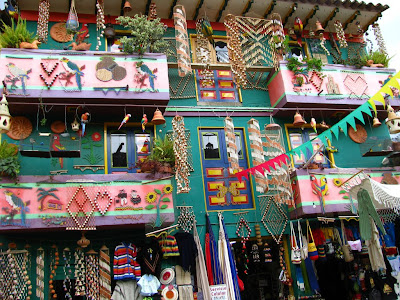
So, you want to get some GREAT SOUVENIRS. Where do you go? Yes, there is an artesan market in Bogotá, but if you want to see endless selection of ceramics, hand made pots and statues, handmade hammocks, ruanas, art, etc. You need to go to Ráquira. Ráquira is the Chibcha name meaning "City of Pots", and that is exactly what it is. Originally, an area of a small Chibcha population governed by the Cacique Suaya and under the authority of the Zaque of Hunza (Tunja), the conquistadors passed through the village on their way to Bogotá in 1537. The city of Raquirá was 'founded' in 1580 by Fray Francisco de Orjuela, on October 18. The Natives of the area were then taught Catholicism by Augustine Monks who founded the first Augustine Monestary in the Americas in 1607 just outside of Ráquira. Ráquira is an amazing place to spend a couple of hours. It is about 20-30 minutes from Villa de Leyva. Make sure to bring your wallet and be prepared to make some amazing finds in this l...

Tía Isabel -- Our Famous Potter of Tiestecitos

Image
In the area surrounding Tutazá (mentioned yesterday), there are many areas -- called veredas . A vereda is a small geographical region that usually has a collection of homes and farms in a rural area -- like a hamlet. One of those veredas is called Tuaté. It was there in a small adobe house with a red, tile roof that my father-in-law was born. His family made their living as potters, a tradition handed down from the orginal inhabitants of the area, and as a child he travelled all over Boyacá, Santander, and Cundinamarca with his father selling the pots and other things that his family made out of clay. Though he left his home at 14 and became successful at something other than pot making, his youngest sister, Isabel, remained and inherited the family home. There she continued the family business. However, her inginuity and creativity lead her to be recognized by a famous French potter -- Dauphine Scalbert. In 1994, Ms. Scalbert wrote an article about Tía Isabel and her pottery and tech...

Souvenir Suggestions -- the RUANA

Image
So, you have adopted a child or will adopt a child from the Altiplano Cundi-Boyacense and you want to purchase them a great souvenir. Something that will reflect the culture of the region where they were born. What should you choose? Might I suggest a RUANA . A ruana is a woolen poncho that has its roots in the ancient Chibcha (Musica) indigenous culture. The story of the ruana starts with the following Chicbha legend: According to the stories told to the Spanish by these Indians, the Chicbhas were once visited by a powerful, yet simple and loving God. This God’s name was Bochica , also known as Nemqueteva , and less often Sadigua . He appeared 3 different times and it seems unclear as to whether it was the same person all three times. Bochica is the most common name associated with the story that relates to the ruana. According to the story, Bochica had white skin and a beard down to his waist – both were unusual as the Indians had dark brown skin and were Lampiños (unable to grow bo...

Pesebre -- "Where is Baby Jesus?"

Image
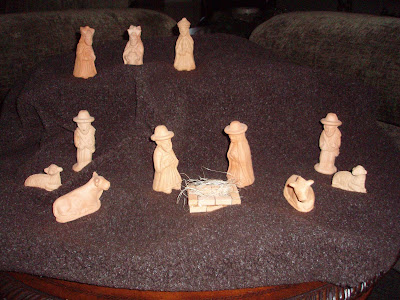
"Where's Baby Jesus?" This is a comment heard every time someone visits our house during the Christmas season. Unlike here in the States, where most perople's Nativity sets are displayed through the season with Baby Jesus is full view, in Colombia the infant is noticably absent. Absent that is until December 24th, when at midnight the children make a big deal of putting the infant child in the manger. This is our Colombian nativity set. It was made in Ráquira, Boyacá. http://www.colombia.com/turismo/sitio/raquira.asp Mary, Joseph, and the Shepherds have a unqie Colombian twist to their attire. They are dressed like Boyancenses -- complete with Ruanas and Sombrero. I thought it would be good to encourage adopting families to purchase a Nativity set while they are in Colombia. This one cost us $5 US. It is small enough to fit in 1/2 of a shoebox, and well worth seeing and using every Christmas. Sorry I a...