Posts

Showing posts with the label San Andrés

Seaflower Biosphere Reserve

On the 9th of November, 2000, UNESCO declared the Archipelago of San Andres, Old Providence and Santa Catalina a new Natural Heritage site, naming it the SEAFLOWER BIOSPHERE RESERVE. As such it is one of 391 ecological zones of this type on the planet. There are three main purposes of the reserve: First, is to converse the landscape, ecosystem, species and the genetic variation of the area. Second, is to encourage sustainable economic and human development, while maintaining the sociocultural roots and ecological stability of the region. Finally, the reserve is to provide logistic support to demonstration projects and educational endeavors on islands with relation to conservation and sustainable development. Here is a government video about the Reserve in Spanish: Here is a tourist video in English: Learn more about the Colombian Agency assigned to oversee the Biosphere Reserve here: http://www.coralina.gov.co/intranet/ You can read a report evaluating the Reserve's first five year...

Old Providence McBean Lagoon

Image
Located in the islands of Providencia and Santa Catalina in the San Andrés Achipeligo , Old Providence McBean Lagoon is Colombia's newest National Park. It was created in 1995 in order to preserve a portion of the island's unique mangrove forests from foreign investors who were desirous to build time-share condos there. The Park covers 90 land hectares and 995 marine hectares and includes about a 10% portion of Providencia's corral reef -- the 2 nd largest reef in the Caribbean. It also includes the Tres Hermanos and Cangrejo Keys. The rainy season is from July to December with the rainiest months being October and November. The park can be reached by flying from San Andrés to Providencia (about a 20 minute flight) or by taking a boat from San Andrés (about 8 hours). [FYI, flights to San Andrés can be taken from Costa Rica, Panamá , or from BOGOTA, CARTAGENA , BARRANQUILLA, MEDELLÍN or CALI.] The great news for you gringos that don't speak Spanish is that ...

Coconut Handicrafts

Image
Until the year 1853, cotton was the major agricultural focus on the Islands (San Andrés , Santa Catalina and Providencia ). However, after this date, agriculture became more and more focused on Coconuts. Coconuts became prevalent in both the gastronomy and economy of the islands. The fiber from the coconut tree branches is used to make hats, baskets, wall hangings and rugs. The shells are used in a myriad of other handicrafts. There are the practical handicrafts -- bowls, spoons, lamps, cups and dishes. Those used to beautify -- necklaces, earrings, bracelets, and belts. Yet another great idea for a Colombian souvenir, particularly if your child was born on the islands or if you choose to visit there. Picture: http://www.free-clipart-pictures.net/tree_clipart.html

Festival de la Luna Verde -- Green Moon Festival

El Festival de la Luna Verde or the Green Moon Festival got its start in 1988, with the 1st annual festival. The Festival was designed to celebrate the Affro Caribbean roots of the islands (San Andres, Santa Catalina and Providencia ). According to an article I read in El Tiempo , the festival is unfortunately no longer held. However, here is what it was like. The party would begin with a parade to all parts of the island, following the roads, accompanied by music. There were marches and dances hearkening back to dances from Ghana and other African places. At night there were music competitions from groups representing European folkloric music like polka and chottis that has influenced the people of the islands. There were also presentations paying homage to the population's African roots. These groups used drums, shells and other native African instruments -- they called this the Congo Meeting. The festival also included musicians from all quarters of the Cari...

Rondón or Rundown -- Not to Miss Cuisine

Image
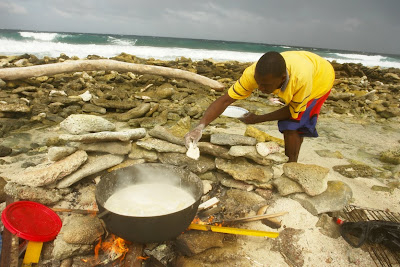
One of the classic dishes of the Islands (San Andrés, Santa Catalina and Providencia) is Rundown or Rondón. Using coconut milk as the broth base, you add snail, pig tail, and fish (sometimes shrimp, crab or lobster are added) as the meat. You also add to the meat green plantains, yuca, breadfruit, yams, dumplings and spices. It is usually cooked outside and most often on the beach in a large pot over an open fire. This unique and VERY typcial dish is well worth a whirl if you get a chance to visit San Andrés while in Colombia * Photos http://www.flickr.com/photos/maqroll/2203197615/in/photostream/ http://www.flickr.com/photos/maqroll/2203991330/in/photostream/

San Andrés and Providencia

Image
One of the most important places for Afrocolombians are the islands of San Andrés, Providencia and Santa Catalina. They have an amazing history, which is as follows: During the 1600's, while Spain and Portugal flourished because of their possessions in the new world, France and England became jealous and angry. They wanted a piece of the pie. However, Pope Alexander I had divided the New World in 1493, drawing an imaginary line between the North and South Pole, giving Portugal possession of lands on one side and Spain possession of lands on the other side. As a result, France and England were excluded from the riches of the New World. The English adopted a belligerent attitude and in 1558, they began an organized, state sponsored, campaign of piracy -- known in English as PRIVATEERING. This tactic was designed to weaken Spain. Pirates such as Sir John Hawkins, Sir Francis Drake, and Henry Morgan stole from the Spanish Armada as they attempted to take the riches from America back to...