Posts

Showing posts with the label Cauca River Valley

Wednesday's Wonders: Pandebono

Pandebono just screams Valle del Cauca!! It is a delicious cheese bread, but ever so hard to get right here in the U.S. I have tried several internet recipes to no avail. However, I did find one that I like. Well, it is an acceptable approximation, even Colombian Daddy approved. I refer you the the following website for the recipe. However, please not that while the title of the blog is My Colombian Recipes, a lot of the recipes are not Colombian. I also haven't tried many of the recipes, so I can't vouch for their authenticity. I think the key to this recipe is the Feta cheese -- just enough, not too much. http://www.mycolombianrecipes.com/pandebono-colombian-cheese-bread

Myths for Monday -- La Tunda

Image
The myth of La Tunda comes from the Colombian Pacific region (think Buenaventura) and is common among Afrocolombians throughout today's department -- Valle del Cauca (fondly called el Valle). It is used to scare people into behaving correctly. So, here goes: La Tunda La Tunda, when seen as herself and not in one of her shapeshifting forms, is a very ugly woman. Some people say that one of her feet is shaped like a MOLINILLO (the wooden stick used to stir chocolate in Colombia). Others say that the foot is made of the root of the tingui-tingui tree. The other leg looks like that of a child. Either way, it is not very appealing. She hunts along the coast for children who have not been baptized (los moritos), disobedient children, and unfaithful men. To each of them, she appears as their mother or another loved one and lures them into the jungle. Once in the jungle, she feeds them shrimp and crab that she farts on. Something about that fart hypnotizes her prey and makes them ...

Myths for Monday -- The Paez Version of Creation

Image
The PAEZ Indians of Colombia, also known as the NASA , are found in an area called Tierradentro in the Department of Cauca (today's department) and Huila. Based on their total population, they are the second largest indigenous group in Colombia with a little less than 140,000 people. In 1536, the Spanish conquistador, Sebastian del Belalcazar, tried to subdue the Paez Indians, but to no avail. Later, Belalcazar ordered the construction of a city -- San Vicente de Paez, right in the heart of Tierradentro. However, in short order, the Paez had destroyed the city. Belalcazar was reported to have said, "What we don't win with our weapons, we will win with our priests!" Indeed, the next weapon tried to pacify the Paez was the Catholic religion. However, this tactic was also unsuccessful. One priest reported, "The Paeces are the most barbarian of any people found in these new lands. They resist everything....They laugh out loud when they are taught (the catech...

One Family's Return Trip: El Parque Nacional del Café

Image
We finally made it to the Eje Cafetero (the Coffee Axis). The Coffee growing region known as the Eje Cafetero consists of the departments of Caldas (Manizales), Risaralda (Pereira) and Quindio (Armenia). On a bright sunny morning, we were off to Quindio to go to the National Coffee Park. This park is truly on the list of PLACES NOT TO MISS !!! It is part museum, part botanical garden, part Disneyland. Unlike many of the other places we visited, the Coffee Park was a little pricey, however, I would recommend that you purchase the Pasaporte Multiple that currently is $49, 500 pesos (about $25 US). This allows you to see all of the attractions and ride any ride over and over. The 7 Aventuras costs less, but you can only do 7 things -- which means if you visit the museum you can only go on 6 rides -- this includes the chair lift to get you to and from the bottom of the park. If you use the lift, you are left with 4 things to do one of which absolutely needs to be the SHOW DEL CAFE. Do not ...

One Family's Return Trip: El Alcarabán

Image
My sister-in-law's family owns a " finca " (kind of like a cabin, but with fruit trees instead of pine trees), just outside of Pereira . It is called el Alcarabán , after the birds that live on the property. The birds nest on the ground. If you happen to get too close to their nests, they whiz down at you squawking like crazy. You have to hit the dirt to avoid having them attack you. All of the boys thought this was hilarious . "They are dive bombing us!" Came the cry of four glee filled boys making machine gun fire sounds. The boys (and their mom) got to check out our Paso Fino skills on this horse. It is a pretty bouncy experience. And of course, what trip to the countryside isn't complete without a swim. Who cares that the rain made it a little chilly. Such an awesome experience. If you are ever invited to someone's finca -- GO!! They are a definite MUST!

One Family's Return Trip: Parque Sarmiento II

Image
Okay, the park not only has a swimming play land, but it also has a river. We arrived after a rain storm and it was running pretty high -- up to the boys' knees -- and my older son was sure that by walking in the river he was demonstrating his Bear Grylls skills . Anyway, they were able to walk the length of the river in the park (about 1/2 mile), while we followed along on a paved path complete with pretty covered bridges. At the top of the park, the boys (Dads included) were able to ride in inner tubes and enjoy a mud fight. If you ask my boys, this was one of the highlights of their trip.

One Family's Return Trip: Buga

Image
Guadalajara de Buga is one of the oldest cities in Colombia. It was founded in 1555 at the order of Belalcazar. Today, it is most famous for its Basilica del Señor de los Milagros . The Basilica houses a special wooden statue of Christ. Here is the story: One day, shortly after the founding of the city (in a date unknown and unspecified), an Indian woman who had recently been converted to Christianity (who has no recorded name) was washing clothes in the river. Suddenly, she saw a small wooden statue if Christ float by. She grabbed it and went home and planted it in the dirt floor of her room. Upon awakening, she discovered that the Christ statue had grown. Soon, people were coming to see the Cristo de las Aguas (Christ of the Waters), as it became called. People began worshipping it and adoring it, kissing it, touching it, etc. Soon, the archbishop of Popayán heard of the statue and became angry. He ordered that it be burned. The story goes that in 1665, the statue was thrown into a f...

One Family's Return Trip: Cali Restaurant Suggestion

Image
I wish that this picture were as good as the breakfast we ate at KUTY. KUTY is a PANADERÍA (bakery), and so much more. Actually, it originally opened its doors in 1975, when a pair of sisters decided to try their hand at bread making in Junín. Now, there are new owners and 4 locations in Cali. We visited the one on la Avenida Sexta con 27. It is like a small cafeteria with tables outside. We ordered their signature dish -- omelets. Whatever you decide to order, don't forget to try their Pan de Bono. If you don't want to leave your hotel, you can order in 524-3040. There are actually 2 KUTY restaurants in Bogotá, one right near the Plaza de Bolívar -- Carrera 8 No. 15 -96. So, even if you never make it to Cali. You can get a breakfast Caleño.

One Family's Return Trip: Goodbye Bogotá, Hello Valle

Image
We arrived in Cali at about 7 am, and fortunately for me the day was cool. (I was wearing a sweater a real rarity in Cali). We were met by my Brother-in-law whom we haven't seen for many years -- tears all around. With luggage safely stored in his trunk, we were off to see the sights. One of the mandatory tourist sites of Cali is the statue of Sebastián Belalcázar which overlooks the city. And on the day that we arrived in Cali, this group of tourists was no exception. My Brother-in-law took us to see this and other sites in Cali straightaway. Belalcazar was one of the original Conquistadores of Colombia. Born Sebastián Moyano in about 1480. He was left an orphan and raised by his brother. He later chose to take as his last name the name of the city near where he had grown up. How he arrived in the Americas is disputed. Some say he came with Colombus on his third trip in 1498. Others believe he came with Pedrarias Dávila, and then went on to explore the Darién with Vasco Balboa. W...

Best Colombian Restaurants 2010

Are you interested in gourmet Colombian food? Well, I have some options for you! Last month, the Premios (Awards) La Barra, were handed out for the best restaurants in Colombia. Four restaurants from different regions of the country were recipients of the awards -- they include: Platillos Voladores -- in Cali, Valle del Cauca What to order? Chorizos picantes cocinados en guarapo con calamares fritos -- Chorizo with fried squid Address: calle 14 norte No. 9 - 32, en el famoso barrio Granada El Mezón Español -- in Pereira, Risalda What to order? Paella -- Spanish rice and seafood dish Address: calle 14 con carrera 26 La Provincia -- Medellín, Antioquia What to order? Gallina rellena con arroz de yerbas -- Chicken stuffed with herbed rice. Address: la Milla de Oro, calle 4 sur No. 48ª-179, barrio El Poblado. Londeros Sur -- Cúcuta, Norte Santander What to order? Carne a la parilla -- Colombian BBQ chicken Address: la Avenida Libertadores, sobre el malecón que da al río Pamplonita M...

HEALTH ALERT -- FOR PEOPLE HEADED FOR CALI

Image
If you will be headed to CALI in the next few weeks be aware that the city is currently experiencing an out break of DENGUE FEVER. Unlike Malaria, which typically strikes in rural areas, DENGUE hits both rural and urban areas. So far, there have been 718 suspected cases with an additional 111 confirmed cases. The fever causes severe pain and headaches and for this reason received the nickname -- breakbone fever , can result in death and this week claimed the lives of 4 children and a 24 year old man. It is transmitted by mosquitoes and there is no immunization to protect you from it. A fumigation initiative has been started in Cali, but it would be a good idea to bring repellent. You can read more from the Colombian newspaper EL TIEMPO : http://www.eltiempo.com/colombia/occidente/dengue-en-cali_7132967-1 Photo: http://classroomclipart.com/cgi-bin/kids/imageFolio.cgi?action=view&link=Health_Care_and_Medicine&image=mosquito_4489. jpg & img =0&search=mosquito&cat=a...

Feria de Cali -- Cali Fair

Every year since 1957, Cali has celebrated the Feria de Cana (the Sugar Cane festival) from December 25-30th. The celebrations kick off on Christmas Day with an official parade that starts at 2 pm and runs down the Autopista Sur. Part of the parade includes the Salsodromo, like the Sambadromo of Rio de Janeiro, the Salsodromo is an opportunity for the different Salsa schools to show off their fancy moves. Following the parade, there is a kick off concert (free to the public) where you will hear - what else?? -- SALSA!!! Cali considers itself the World Capital of Salsa!!! This year the concert features Hermes Manyoma. If you won't be able to make the concert, enjoy some of the sounds by clicking here: http://video.aol.co.uk/video-detail/creyendo-en-ti-hermes-manyoma/717232774 The following day, there is a horse parade (cabalgata) and yet another free concert. The next day a parade and concerts. In essence the week is full of dancing and music, parades, bullfights, and competitions. ...

Bambuco

Image
The famous Colombian poet -- Rafael Pombo -- once wrote: “Para conjurar el tedio de este vivir , tan maluco , Dios me depare un bambuco y al punto , santo remedio ” which means In order to avert tedium in this life, so awful. God has sent me a bambuco and with it, a holy remedy. Most musicians, anthropologists, and historians claim that Bambuco has its roots in African mixed with Indigenous culture -- with some Spanish thrown in for good measure. Whatever its roots, however, Bambuco is a uniquely Colombian genre that has spread to other parts of South and Central America. Bambuco is most commonly associated with the following Departments of Colombia: Nariño , Cauca , Valle del Cauca , Tolima , Huila , Antioquia , Risaralda , Quindío , Cundinamarca , both Santanders , and Boyacá . While there are modern singers of Bambuco ( Conjunto Villa María , Trío Palo Santo , and Cuarto Palos ), it is typically considered to be folkloric music. It is based on 3/4 or 6/8 time, ...

Tomate de Arbol

Image
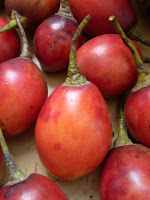
Native to the Andean region, Tomate de Arbol (Tamarillo) is a fruit that is often used to make juice in Colombia. The juice has a bitter sweet, kind of acidic taste. However, don't be confused by the name, it tastes nothing like a tomato. It is most common in the Eje Cafetero and el Valle. The trees that grow the fruit are usually found between 1500-2500 meters above sea level, in temperatures between 15 and 22 degrees celsius. The fruit itself is high in fiber, and vitamins A, B, C, and K. It is also rich in calcium, iron and phosporus. Make sure to give it a whirl while in Colombia. Or purchase the pulp and make oyur own juice at home. Here is a link: http://www.fruitpulp.ca/product/Tamarillo *Photo by ximenacab http://www.flickr.com/photos/ximenacab/2634815284/sizes/l/

Semana Santa in Popayán, Colombia

Image
Perhaps the biggest Semana Santa celebration is in Popayán. Popayán is one of the oldest cities in Colombia, founded in 1537 by Sebastián Belalcázar. Its name, comes from the indigenous words for Two Straw Villages . It referred to the two villages with houses having straw roofs. However, today, it is known as the White City , because of its beautiful white colonial houses. For over 400 years, Popayán has held processions during Holy Week. They are similar to processions held in Spain. These celebrations start on Palm Sunday with a procession that starts at the Basilica de Belén. People participating in the procession carry Palms, white handkerchiefs and flags proclaiming the royalty of Jesus Christ. On Martes Santo (Holy Tuesday), there is another procession where the effigy bearers carry four images from the church of Saint Augustine to the center of the city. Accompanying the procession are the sounds of a solemn requiem. They are met at the church by red-robed men carrying incense...

La Ombligada -- Ties to the Future

Image
There is a cultural tradition known as the “la ombligada ” that is performed on newborn Afro-Colombian children of the Pacific Coast. It is one of the oldest cultural traditions and is performed exclusively by midwives ( parteras ). The midwife’s role is to watch out for the well being of the infant and the mother before and after the birth. Once born, the midwife will tie ( ombligar ) the child to certain elements that are thought to then influence the child throughout his/her life. Let's say that the mother wants her child to be strong, or wealthy, or gifted in some way, then the midwife will tie certain elements to the child’s umbilical cord. For example, if a wealthy child is wanted, pieces of gold are placed on the umbilical cord and then tied on with cloth. If the mother wants a child that will be lucky in love, the beak of the tominé (a bird from the jungles of Chocó ) is used in place of the gold. Toenails of animals are also often used – those of an armadillo mean the ch...

Dancing the Salsa -- Must Have Music

Colombian Nobel laureate, Gabriel García - Márquez , once said, “Any gathering of more than 2 Colombians is destined to turn into a party.” Party, in this case, means a BAILE (Dance). In Colombia, grandparents, parents, and children all DANCE TOGETHER, to the same music ,at the same party. Dancing, in general, is so prevalent, that kids milestones in Colombia include: 1- Crawling 2- Walking 3- Playing Soccer 4- Dancing -- 3 and 4 are interchangeable As a teenager, how well you dance will largely determine how much or how little you socialize. The best dancers have their pick of boyfriends or girlfriends – the worst dancers get the leftovers. So, in Colombia, dancing is a social skill. I was stunned when we picked up our son – then 22 months – and every time he heard music (which was just about everywhere), he would stop and start to dance. (My husband insists that he was NOT surprised.) Colombians dance to many forms of music, however, Salsa is one of the most common. Salsa had its o...

Language of El Valle -- OIGA, MIRE, VEA

In this part of Colombia, there are several very common expressions used to get your attention. Well, it is more like several different version of the same expression. They all translate to -- HEY LOOK, LISTEN! 1 - OIGA , MIRE, VEA 2- OÍS , MIRÁ , VES 3- MIRÁ , VÉ And other combinations that include variations of the above. In some instances, the VÉ (pronounced: beh ) is added to the end of any sentence -- kind of like the stereotypical EH used in Canada. For example, you could hear, "¿ Cómo estás , vé ?" The answer would be, " Muy bien , vé ." Kids in this part of Colombia might say, " Mirá , vé , dame ___." Which means, "Hey, give me ____." Or " Oís , quiero ____." Which w ould mean "Hey, I want ____." The words do not literally mean LOOK or LISTEN. They are just an expression to get someone's attention and it is also considered a respectful preamble to a request. The use of the OIGA , MIRE, VEA is so common, it ...

Souvenir Suggestion -- Bordados de Cartago

The city of Cartago , located about 2 hours from Cali, is known as the embroidery capital of Colombia. Embroidery in the Valle del Cauca has its beginnings in 1540, when the Spanish Conquistadors brought the first hand embroidered items to the area. As the Spanish established themselves in the area, the Spanish women (mostly from Andalusia ) brought with them the skill of embroidery. Gradually, their talents were shared with the native and mestizo peoples of the area. Masters of embroidery then transmitted their art from generation to generation and today, embroidery has become a tradition. In Cartago , entire families are devoted to the art -- embroidering blouses, skirts, guayaberas , and bed and table linens. In appreciation of this tradition and its beauty, might I recommend a weekend or day trip to Cartago where you can purchase a blouse (for a girl) or guayabera (for a boy) as a cultural souvenir for your child/ ren . Check out some of the beautiful designs at the following s...

Abuelita Carmen's Sancocho de Gallina

One of the great traditional soups of the Valle del Cauca is SANCOCHO DE GALLINA (Chicken Stew) . Here is a recipe that you can try at home. 1 whole chicken 1 large onion, chopped 1 cup of tomatoes, peeled and finely chopped 2 Tablespoons butter 3 cloves of garlic, crushed 10 cups of chicken broth 2 ears of corn, cut in several 3 inch long pieces 8 potatoes (preferably Yukon Gold) 2 plantains, green – not ripe, cut into pieces 2 plantains, ripe, cut into pieces 2 yuccas , peeled and cut into pieces salt, pepper and cumin to taste color (optional) cilantro – cut in small pieces (optional) Step #1 In a 8 quart pan, cook onions and tomatoes in melted butter. Step #2 Put chicken and broth in the pan. Then, add the corn on the cob and the unripe plantain pieces. Step #3 Cover and cook on Medium High for about an hour. Step #4 Take out the corn on the cob and add the yucca , ripe plantains, and potatoes. Also add the spices to taste. Cover and cook until the chicken is fully cooked. Check...